
If you live in Connecticut, you already know winter isn’t gentle on outdoor surfaces. Between freezing temperatures, snow, ice, and repeated freeze–thaw cycles, your driveway or patio is constantly under attack. Choosing the right material can mean the difference between a surface that lasts decades—and one that cracks after a few seasons.
The Battle of Durability: Handling Frost Heave
One of the biggest threats to hardscapes in New England is frost heave. As moisture in the ground freezes and expands, the soil shifts upward, then settles again when temperatures rise.
Poured concrete is rigid by nature. While it looks solid and seamless at first, that rigidity is also its weakness. When the ground beneath it moves—even slightly—concrete has very little flexibility. The result? Cracks that widen over time, uneven slabs, and costly repairs.
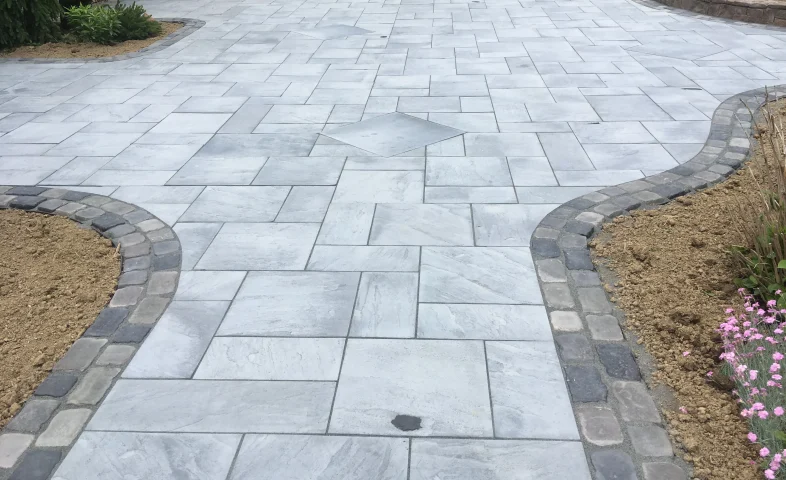
Interlocking concrete pavers, on the other hand, are built to flex. Each paver sits on a properly compacted base and locks together with joint sand. Instead of fighting ground movement, the system moves with it. This flexibility allows pavers to handle Connecticut’s freeze–thaw cycles far better than a single poured slab.
Maintenance & Repairs: The “Crack” Factor
Winter maintenance brings another challenge: de-icing salts. These salts can penetrate poured concrete, leading to surface damage known as spalling, where the concrete flakes, pits, and deteriorates over time.
When poured concrete cracks or spalls, repairs are rarely invisible. Patching often leaves noticeable seams or color differences—and in many cases, the damage continues to spread.
With pavers, repairs are much simpler and cleaner. If a section becomes damaged or settles unevenly, individual pavers can be removed and replaced without disturbing the surrounding area. No saw cuts, no patch lines—just a restored surface that looks like new.
Cost Comparison: Upfront Price vs. Long-Term Value
There’s no denying it: pavers typically cost more upfront than poured concrete. However, the long-term picture tells a different story.
Poured concrete often requires crack repairs, resurfacing, or even full replacement as winter damage accumulates. Those costs add up quickly.
Pavers offer lower long-term maintenance costs and a longer lifespan when installed correctly. Their durability, repairability, and resistance to winter damage often make them the more cost-effective choice over time—especially in harsh Connecticut climates.
Why Proper Site Prep Matters (The Valley View Difference)
No matter which material you choose, performance in winter comes down to proper site preparation. At Valley View Excavating, this is where we set ourselves apart.
We focus on:
- Thorough excavation to remove unstable soil
- A professionally installed, compacted base that resists shifting
- Smart drainage solutions that prevent water from pooling and freezing
Without these steps, even the best materials can fail. With them, pavers—and even concrete—stand a much better chance against Connecticut winters.
Ready to install a driveway that survives the winter?
Contact Valley View Excavating in Plainville, CT for a free quote and invest in a surface built to handle New England weather year after year.