
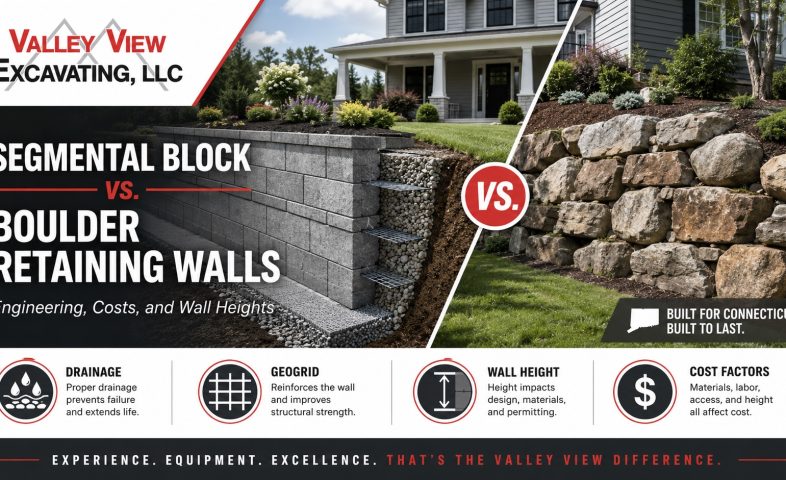
Segmental block retaining walls offer precise grades, uniform appearance, and engineered geogrid reinforcement for taller or heavily loaded walls. Boulder retaining walls rely more heavily on the mass, placement, batter, drainage, and interlock of large natural stone. In Connecticut, there is no universal rule saying every wall under 4 feet can be built without engineering. The current Connecticut State Building Code exempts retaining walls no higher than 3 feet from a building permit only when they do not support a surcharge. Taller walls, driveways above the wall, steep slopes, weak soils, groundwater, or structures near the wall can change both permit and engineering requirements.
At Valley View Excavating, LLC, we look at retaining walls as structural earthwork first and landscape features second. A wall that looks good but lacks proper base preparation, drainage, reinforcement, or soil compaction can become a costly problem after Connecticut freeze-thaw cycles and heavy rain.
Segmental Block vs. Boulder Retaining Walls
The biggest difference between retaining wall block vs stone is how each system resists soil pressure.
Segmental retaining wall blocks create a manufactured wall face made from interlocking concrete units. Low walls may work as gravity systems, while taller walls often use layers of geogrid extending back through compacted soil. Geogrid connects the block facing to a much larger reinforced soil mass rather than asking the blocks alone to resist the earth behind them.
Boulder walls rely on large stone mass, careful placement, setback, and stable bearing material. They create a more natural New England appearance and can work especially well on wooded lots, broad slopes, and landscapes where a manufactured block wall may feel too formal.
Our Connecticut retaining wall contractor services cover structural and landscape retaining walls throughout Plainville and surrounding Central Connecticut communities.
When Does a Block Wall Need Geogrid?
Wall height alone does not determine whether geogrid is required.
Important factors include:
- Soil type behind the wall
- Slope above the wall
- Driveways or parking areas above it
- Structures near the retained soil
- Groundwater and drainage
- Wall setback
- Multiple wall tiers
- Total retained height
VERSA-LOK notes that many segmental systems generally require geogrid once walls reach roughly 3 to 4 feet, while shorter walls may also require reinforcement when slopes, loads, poor soils, or other unfavorable conditions are present.
That is why we do not treat geogrid as an optional add-on after construction starts. Reinforcement length, spacing, and soil compaction should be considered during design.
How High Can a Retaining Wall Be Without an Engineer?
This question often gets confused with permit requirements.
Under Connecticut’s currently effective 2022 State Building Code, retaining walls not higher than 3 feet, measured from finished grade at the bottom to finished grade at the top, can fall under the permit exemption when they are not supporting a surcharge. Connecticut’s planned 2026 code effective date has been delayed, so the 2022 code remains the applicable statewide code at publication.
That does not mean every 3-foot wall is automatically safe without engineering.
A driveway, steep uphill grade, building, heavy equipment area, poor soil, or tiered wall can create extra loads. Segmental wall manufacturer guidance commonly recommends project-specific professional engineering for walls in the 3 to 4 foot range and above when site conditions warrant it.
For current statewide requirements, review the Connecticut State Building Code and confirm local requirements with the municipal building department before construction.
What About Connecticut Frost Depth?
Connecticut’s building code requires qualifying foundations and permanent structural supports to receive frost protection, with one listed method extending at least 42 inches below finished grade.
Segmental retaining walls, however, are commonly built as flexible systems over engineered granular bases rather than as conventional rigid concrete foundations. The correct base depth depends on the wall system, soil, drainage, frost exposure, and engineered design.
What matters most is removing weak organic soil, creating a properly compacted aggregate base, controlling groundwater, and preventing trapped water beneath and behind the wall.
Boulder Retaining Wall Cost vs. Block Wall Cost
There is no reliable single boulder retaining wall cost that works for every Connecticut property.
A boulder wall may become cost-effective when suitable stone is readily available and an excavator has easy access. Cost can rise quickly when large stone must be transported, sorted, rotated, and individually placed.
Segmental block walls usually create a more predictable material takeoff, but taller walls may require:
- Additional excavation
- Drainage stone
- Geogrid reinforcement
- More compacted structural fill
- Additional block courses
- Caps and finished corners
- Engineering plans
Access can matter as much as material. A backyard wall requiring small equipment and hand movement may cost far more than a similar wall beside an open driveway.
Which Wall Should We Choose?
Choose segmental block when clean geometry, formal landscaping, patios, stairs, tight grades, or engineered tall-wall construction are priorities.
Choose boulders when a natural appearance, broad landscape slopes, woodland settings, or rugged New England character better match the property.
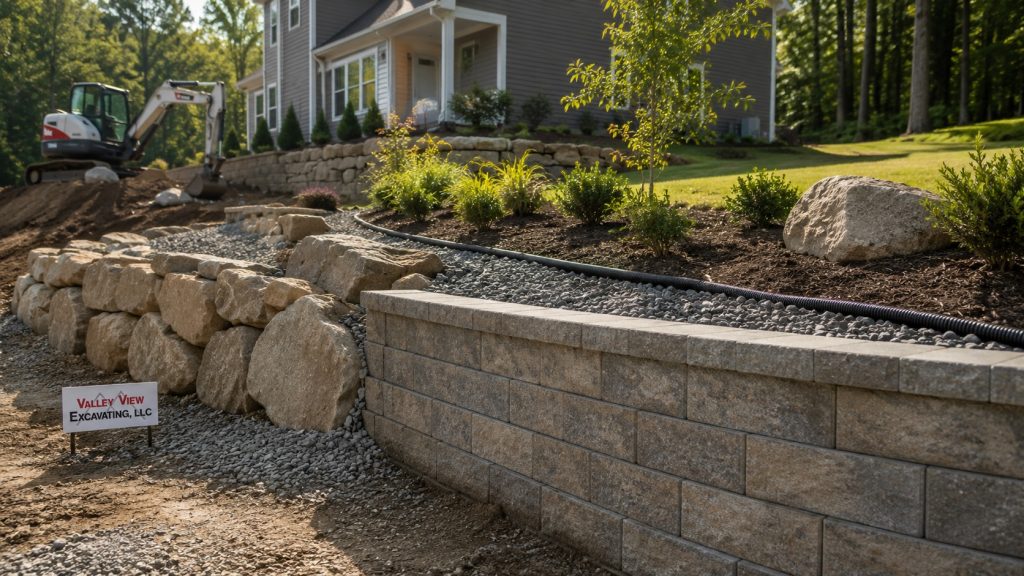
Some projects benefit from both. Boulder walls can stabilize larger landscape areas while manufactured block creates cleaner transitions around patios, stairs, and outdoor living spaces. Our hardscaping services include retaining walls, patios, pavers, stonework, and related site preparation.
Build the Wall Around the Site Conditions
A retaining wall is only as dependable as the soil, drainage, base, reinforcement, and grading around it.
Before choosing block or boulders based only on appearance, we evaluate wall height, retained soil, water movement, access, surcharge loads, and how the surrounding property will be used.
Request a structural retaining wall consultation and design bid from Valley View Excavating, LLC.