
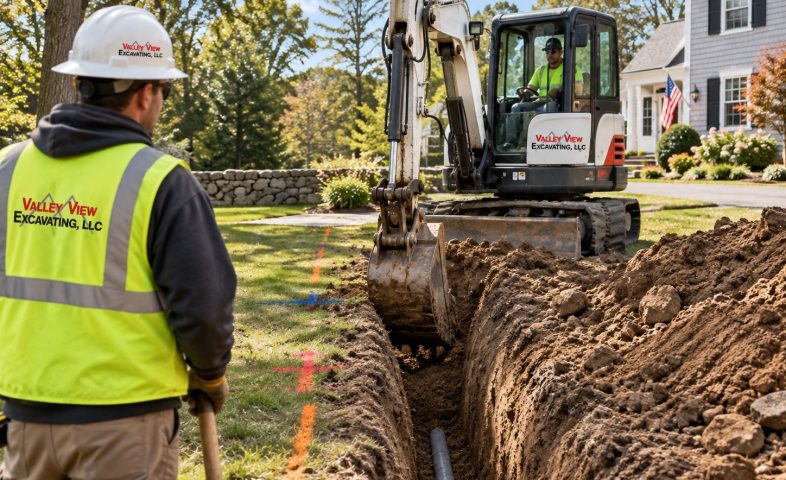
Trenching cost per foot varies widely because linear footage is only one part of the job. Straightforward excavation may fall within broad national planning ranges of several dollars per foot, but Connecticut projects can cost considerably more when ledge, groundwater, deep trenches, tight access, utility crossings, bedding, backfill, compaction, or surface restoration are involved.
When homeowners or contractors ask us how much trenching costs per foot, the most important answer is that the scope behind each foot matters more than the footage alone.
A shallow drainage trench through open soil is very different from a deep sewer trench crossing a driveway or a utility trench cut through Connecticut ledge.
How Much Does Trenching Cost Per Foot?
National consumer cost guides often place basic trench excavation around $5 to $12 per linear foot for straightforward work. More complex trenching can move considerably higher.
These figures should only be used for early planning. They are not Valley View Excavating’s Connecticut pricing.
A trench estimate can change based on:
| Trenching Variable | Why It Changes Cost |
|---|---|
| Length | More excavation, bedding, backfill, and material |
| Depth | More soil removal and added safety requirements |
| Width | Greater excavation and material volume |
| Soil | Loose soil differs from clay, till, or dense material |
| Ledge or rock | May require hydraulic hammering or specialized removal |
| Access | Tight yards can limit machine size and production |
| Groundwater | May require pumping or water control |
| Existing utilities | Requires slower, careful excavation |
| Restoration | Lawn, gravel, asphalt, or concrete may need rebuilding |
| Spoil disposal | Excess material may require hauling |
Complete utility installation usually costs more than excavation alone because pipe, conduit, connections, stone, bedding, permits, testing, and restoration may be separate parts of the project.
Why a 100-Foot Trench Does Not Always Cost 100 Times the Per-Foot Rate
Multiplying a national trenching cost by 100 feet can create a rough budgeting number, but it rarely produces an accurate contractor quote.
Most projects include fixed or semi-fixed costs such as equipment mobilization, trucking, operator time, utility locating, site setup, safety preparation, cleanup, permits when required, and restoration.
A short trench through rock, pavement, or a confined yard may therefore cost more per foot than a long trench across an accessible open area.
Water Line Trenching Cost
Water line trenching cost depends on much more than the distance from the source to the building.
Factors can include:
- Required burial depth
- Frost protection
- Pipe diameter
- Existing utility crossings
- Foundation entry
- Bedding material
- Backfill
- Final connections
- Lawn or driveway restoration
Burial requirements can vary by project, municipality, utility, site conditions, and applicable code. That is why we avoid assigning one universal water-line trench depth or one fixed price per foot.
Sewer Line Trenching Cost
Sewer excavation can be more involved because gravity sewer systems depend on planned elevations and proper pitch.
A sewer line cannot simply follow the easiest excavation depth.
Cost may be affected by trench depth, pipe bedding, connection elevation, cleanouts, foundation penetrations, municipal sewer location, septic connections, driveway crossings, and backfill compaction.
Valley View Excavating has extensive experience with sewer excavation and underground piping throughout Plainville and surrounding Connecticut communities.
Electrical Conduit Trenching Cost
Electrical trenching is commonly needed for:
- Detached garages
- Generators
- Pool equipment
- Outdoor lighting
- New residential service
- EV charger conduit
- Barns and workshops
The excavation contractor may prepare the trench while a licensed electrical contractor handles regulated electrical work such as conductors, connections, inspections, and certain conduit requirements.
Electrical trenching cost can change with depth, conduit quantity, utility crossings, rock, bedding, warning requirements, access, backfill, compaction, and restoration.
Drainage Trenching Cost
Drainage projects can include French drains, solid pipe, buried downspouts, catch-basin connections, foundation drainage, stormwater piping, and outlet trenches.
Cost drivers include:
- Perforated or solid pipe
- Stone quantity
- Filter fabric
- Trench width
- Excavation depth
- Required pitch
- Outlet location
- Dry wells or catch basins
- Soil disposal
- Lawn restoration
Our professional excavation services cover drainage, underground piping, sewer work, septic work, and general excavation throughout Central Connecticut.
Why Trenching Through Ledge Costs More in Connecticut
Connecticut properties frequently contain boulders, glacial material, and shallow bedrock.
When ledge appears in the planned trench path, ordinary bucket excavation may no longer be enough. The work may require a hydraulic hammer, rock breaking, larger equipment, additional operator time, hauling, or a different trench alignment.
Rock can turn what looks like a routine utility trench into specialized excavation very quickly.
How Trench Depth Changes the Price
A deeper trench does not simply mean a few additional scoops of soil.
Increasing depth can mean more excavated material, wider working areas, more difficult access, greater groundwater exposure, additional spoil management, more bedding, increased backfill, and more compaction work.
Trench depth can also introduce additional safety requirements.
OSHA generally requires protective systems for trenches five feet deep or greater unless the excavation is entirely in stable rock, with additional engineering requirements applying to very deep excavations.
Soil, Boulders and Groundwater Can Change an Estimate Fast
Three site conditions regularly change excavation scope in Connecticut.
Soil: Dense, unstable, wet, or difficult material can reduce production rates.
Boulders and ledge: Rock cannot be removed at the same speed as ordinary soil and may require specialized equipment.
Groundwater: Water entering an open trench may require pumping, rerouting, or other controls before installation can continue safely.
These conditions are difficult to account for accurately using a simple online cost-per-foot calculator.
What Is Usually Included in a Trenching Estimate?
We recommend comparing the entire scope of each estimate rather than looking only at the per-foot number.
Ask whether the quote includes:
- Mobilization
- Excavation
- Spoil stockpiling
- Bedding stone
- Pipe or conduit installation
- Backfill
- Compaction
- Excess-soil removal
- Pavement cutting
- Asphalt repair
- Lawn restoration
- Permit coordination
Two quotes with different per-foot numbers may cover very different amounts of work.
Call Before You Dig in Connecticut
Underground utilities need to be identified before powered excavation begins.
Connecticut’s Call Before You Dig system requires advance notification for most powered excavation work. Utility coordination is also an important part of safe trench planning.
This step matters whether the project involves a sewer line, electrical conduit, water service, drainage pipe, or another buried utility.
Trenching vs. Directional Boring
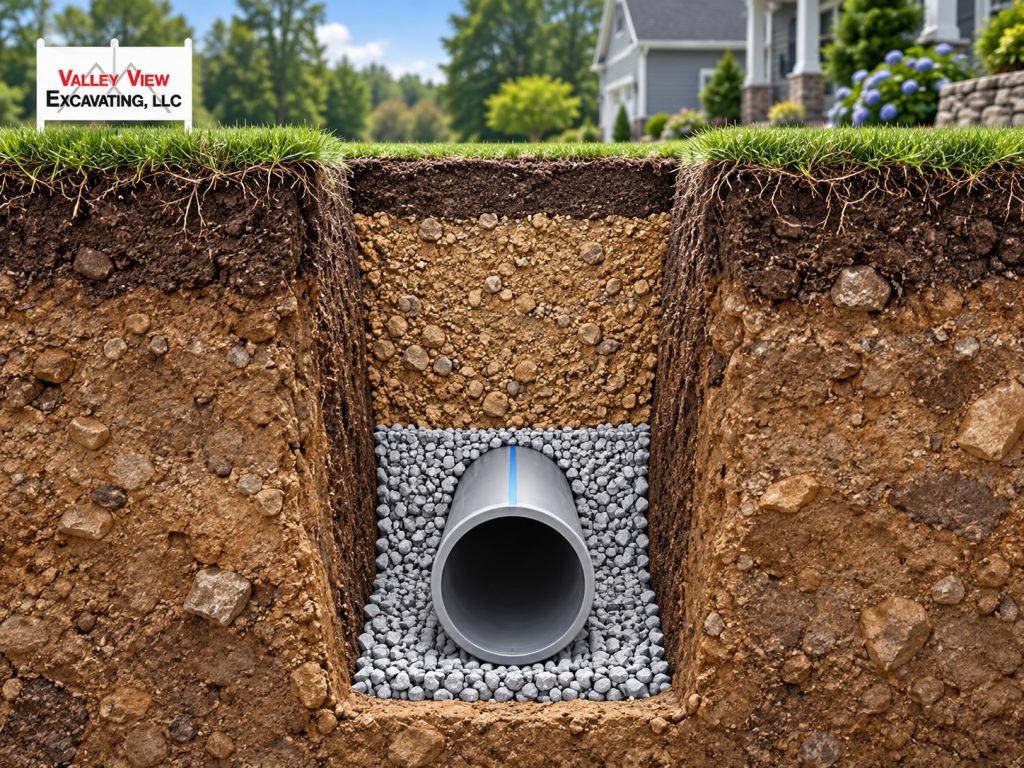
Open trench excavation works well where surface access is available, pipe bedding or drainage stone must be installed, an existing pipe needs to be exposed, or surface restoration is practical.
Directional boring may be considered for some crossings under driveways, roads, hardscape, or other obstacles.
The two methods should not be compared only by price per foot because their scope, equipment, and restoration requirements can be very different.
Get a Site-Specific Trenching Estimate in Connecticut
A national trenching cost per foot can help with early budgeting, but a reliable estimate requires knowing what the trench actually needs.
We evaluate route, access, soil, ledge, depth, groundwater, existing utilities, disposal, bedding, backfill, compaction, and restoration before pricing the work.
Valley View Excavating has served Plainville and surrounding Connecticut communities since 2007 with residential, commercial, sewer, septic, drainage, and general excavation services.
Request a site-specific excavation estimate before relying on a simple per-foot calculator.
Frequently Asked Questions
How much does it cost to trench 100 feet?
Multiplying a national per-foot estimate by 100 can provide a rough planning number, but mobilization, depth, ledge, utilities, backfill, and restoration can make the actual contractor quote significantly different.
How much does trenching cost per linear foot?
National consumer guides often place straightforward trench excavation around $5 to $12 per linear foot. Complex projects can cost more. These are broad national figures, not Valley View Excavating’s Connecticut pricing.
Is sewer trenching more expensive than drainage trenching?
Often, but not always. Sewer work may require greater depth, precise elevations, bedding, and connections. Drainage cost depends heavily on trench width, stone, pipe, fabric, outlet design, and restoration.
Does rocky soil increase trenching cost?
Yes. Boulders or bedrock can slow excavation and may require hydraulic hammering, larger equipment, additional hauling, or alternate trench routing.
Do we need to call 811 before trenching in Connecticut?
Powered excavation generally requires notification through Connecticut’s Call Before You Dig system before work begins.