
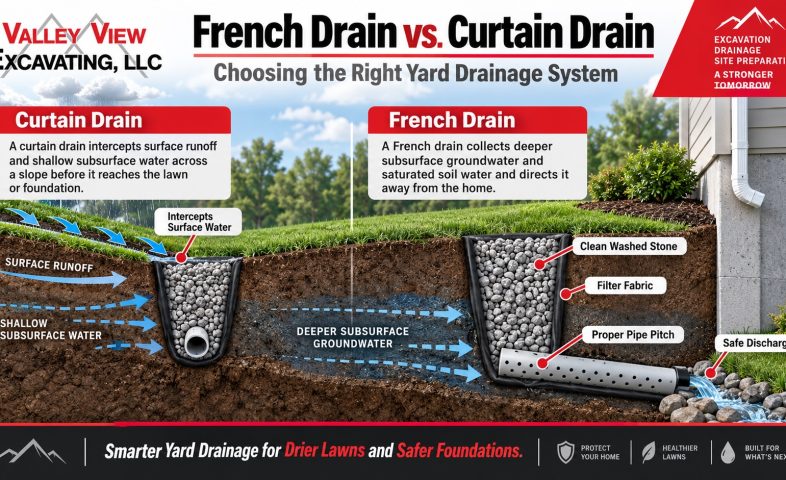
The right system depends on where the unwanted water is moving. A curtain drain is generally a shallower interception trench placed across a slope to catch runoff and shallow subsurface water before it reaches a lawn, foundation, patio, or other low area. A French drain typically works deeper in the soil profile, using clean drainage stone and perforated pipe to collect persistent subsurface water and move it toward a safe outlet. At Valley View Excavating, LLC, we evaluate grade, soil type, groundwater, downspouts, hardscape runoff, and the final discharge point before recommending either option. Our goal is not simply to hide standing water. We want to control where water travels across the entire property.
Curtain Drain vs. French Drain: What’s the Difference?
The systems look similar because both can use an excavated trench, drainage stone, filter fabric, perforated pipe, and a gravity-fed outlet.
Their placement and purpose are different.
Curtain Drain
A curtain drain typically runs across a slope, often uphill from the area that needs protection.
We use this type of drainage to intercept water before it reaches:
- Low lawn areas
- Foundations
- Walkout basements
- Patios
- Retaining walls
- Downhill planting beds
Think of the drain as an underground curtain that catches water moving down the property.
French Drain
A French drain is commonly used where soil remains saturated below grade.
Typical applications include:
- Soggy lawns that remain wet after rain
- High groundwater conditions
- Foundation-side drainage
- Water collecting behind retaining walls
- Low areas with persistent subsurface saturation
A properly installed French drain provides a path of less resistance through clean aggregate and perforated pipe. University of Minnesota Extension describes French drains as gravel-filled trenches with perforated pipe that can capture both surface infiltration and groundwater, with deeper systems intercepting more groundwater.
Which Drain Helps Fix Standing Water in a Lawn?
To fix standing water in a lawn, we first determine where the water originates.
If rainfall is flowing downhill from another part of the property and collecting in a low area, intercepting that water uphill with a curtain drain may work well.
If the lawn remains soft and saturated long after rainfall has stopped, the problem may be beneath the surface. Poor-draining soil, a high seasonal water table, compacted layers, or groundwater movement may make a French drain more appropriate.
Valley View Excavating’s yard drainage solutions start with site evaluation because drainage systems perform best when trenching, grading, pipe placement, and discharge location work together.
Why Gravel Selection Matters
The stone surrounding a perforated drainage pipe needs open space between particles so water can move freely.
For most buried drainage systems, we prefer clean, washed angular stone without excessive fines.
Dense materials containing lots of stone dust can compact tightly. That is useful under driveways and patios, but it can restrict water movement around a drainage pipe.
The stone envelope performs several jobs:
- Creates pathways for water
- Supports the pipe
- Reduces soil contact with perforations
- Provides temporary water storage
- Helps distribute groundwater into the system
Decorative stone should not be selected only because it looks attractive. Drainage performance comes first.
Why Filter Fabric Is Important
A drainage trench surrounded by soil can gradually become contaminated with sediment.
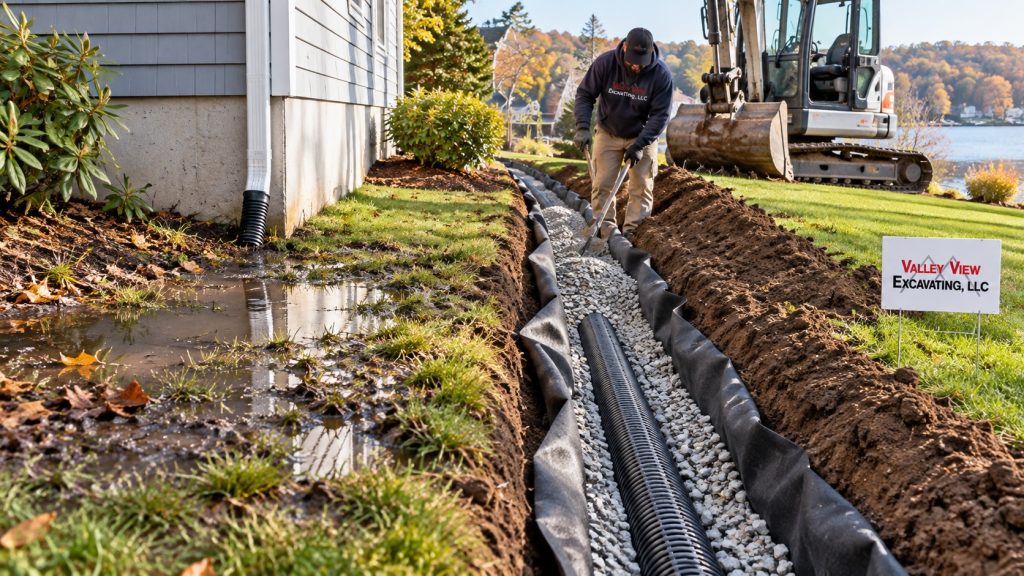
Filter fabric helps separate native soil from drainage aggregate while allowing water to enter the stone zone.
A common installation sequence looks like this:
- Excavate the trench.
- Establish the correct bottom elevation.
- Line the trench with appropriate geotextile fabric.
- Add clean drainage stone.
- Install perforated pipe.
- Surround the pipe with additional stone.
- Wrap or close the fabric around the drainage zone.
- Restore the surface.
Filter materials are used in subsurface drainage systems specifically to reduce the movement of fine soil particles into the drain.
Drainage Pipe Pitch Matters
Water still needs somewhere to go.
A perfectly built French or curtain drain can fail if the pipe has no usable outlet or contains low spots that trap water.
We establish elevations before excavation so the drain maintains positive gravity flow toward an appropriate discharge location.
Depending on the property, the outlet may involve:
- Daylight on a lower portion of the site
- Dry well
- Approved stormwater connection
- Pop-up emitter
- Other permitted drainage structure
The correct outlet depends on grading, neighboring properties, local requirements, and the amount of water being managed.
Water should never simply be redirected toward another home or create erosion farther downhill.
Don’t Send Gutter Water Into Every French Drain
Roof runoff creates a large amount of concentrated water quickly.
When downspouts are part of the problem, we generally prefer dedicated solid drainage pipe rather than allowing roof water to discharge directly into a perforated French drain beside the foundation.
Solid pipe carries water away without intentionally releasing it into already wet soil.
Our drainage planning often combines French drains with buried downspout extensions, grading, catch basins, or foundation protection when one system cannot solve the entire problem.
When Regrading May Be Better Than Either Drain
Not every wet lawn needs underground piping.
If the problem comes from obvious low spots or soil pitched toward the home, correcting the grade may provide a simpler solution.
We may recommend regrading when:
- Water visibly flows toward the foundation
- A lawn contains isolated depressions
- Runoff from a driveway crosses the yard
- Soil has settled near the house
- Surface water has no clear route away
Persistent underground saturation may still require drainage after grading.
Our guide to common yard drainage problems explains how standing water, soggy lawns, downspouts, grading, and subsurface drainage can interact.
Choose the Drain Based on Water Movement
The curtain drain vs. French drain decision should start with a simple question:
Where is the water coming from?
Water moving down a slope may call for shallow interception. Persistent groundwater or saturated soil may require a deeper French drain. Foundation problems may require drainage, grading, waterproofing, or several systems working together.
At Valley View Excavating, LLC, we provide excavation-based yard drainage solutions throughout Plainville and surrounding Connecticut communities. We evaluate the source, elevation, soil, trench route, pipe pitch, drainage stone, filter fabric, and discharge point before the first trench is dug.
A drainage system should not simply move water. It should move water to the right place.