
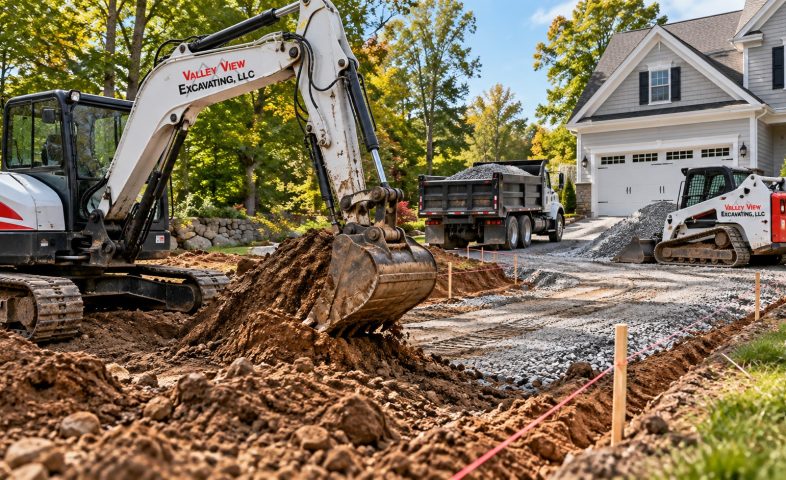
Driveway excavation typically costs $1,000 to $2,500 for straightforward residential projects, based on 2026 national cost estimates. More complex excavation involving rocky soil, steep slopes, difficult equipment access, or substantial drainage work can cost significantly more. In Connecticut, the final driveway excavation cost depends on excavation depth, soil conditions, grading requirements, material disposal, and aggregate base preparation.
How Much Does Driveway Excavation Cost in 2026?
Planning a new driveway involves more than choosing asphalt, concrete, or gravel. The ground beneath the finished surface must be properly excavated and prepared.
At Valley View Excavating, LLC, we help Connecticut homeowners establish stable driveway foundations through professional excavation, grading, and site preparation.
According to Angi’s 2026 excavation cost guide, straightforward driveway and patio excavation projects commonly fall between $1,000 and $2,500 nationally.
However, this range does not necessarily include every component of a complete driveway installation.
Average Driveway Excavation Cost Breakdown
| Project Scope | Estimated National Cost |
|---|---|
| Basic driveway or patio excavation | $1,000 to $2,500 |
| General residential excavation projects | $1,659 to $6,713 |
| Specialized rock or ledge removal | $1,000 to $20,000+ |
These are national planning ranges for different project categories, not additive charges or published Valley View Excavating prices. Actual Connecticut quotes depend on site conditions.
Understanding what affects these costs helps homeowners develop a more realistic budget.
6 Factors That Affect Driveway Excavation Cost
1. Driveway Size and Excavation Depth
Larger driveways generally require more excavation, equipment time, and material handling.
A short residential driveway may need limited soil removal. A long driveway with substantial elevation changes can require considerably more work.
Excavation depth also matters.
We determine the required depth based on existing soil conditions, proposed pavement thickness, aggregate requirements, and drainage design.
Removing additional soil increases excavation volume and disposal costs.
2. Soil Conditions and Connecticut Ledge
Connecticut properties frequently contain compacted glacial soils, clay, large rocks, and shallow bedrock.
These conditions can make excavation more difficult.
For example:
- Loose soil is generally easier to excavate.
- Dense clay may require additional grading and stabilization.
- Large buried boulders can slow excavation.
- Solid ledge may require specialized breaking equipment.
At Valley View Excavating, we evaluate ground conditions before recommending the appropriate excavation method.
3. Existing Driveway Removal
Replacing an old driveway may require removing asphalt, concrete, or deteriorated aggregate before excavating the underlying soil.
This can involve:
- Breaking and removing existing pavement
- Loading demolition debris
- Transporting material for disposal or recycling
- Removing unstable underlying soil
- Regrading the exposed driveway area
A new driveway built on previously undeveloped ground may require different preparation than replacing an existing paved surface.
4. Drainage and Grading Requirements
Proper drainage is essential for long-term driveway performance.
Water trapped beneath pavement can weaken the base, contribute to settlement, and increase freeze-thaw damage.
We evaluate how stormwater moves across the property before establishing the finished driveway grade.
Depending on the site, drainage improvements may involve swales, culverts, catch basins, or underground drainage piping.
Properties with steep slopes or persistent water problems may require additional excavation and grading.
5. Gravel Base Installation and Compaction
Driveway site prep cost often includes installing a compacted aggregate foundation.
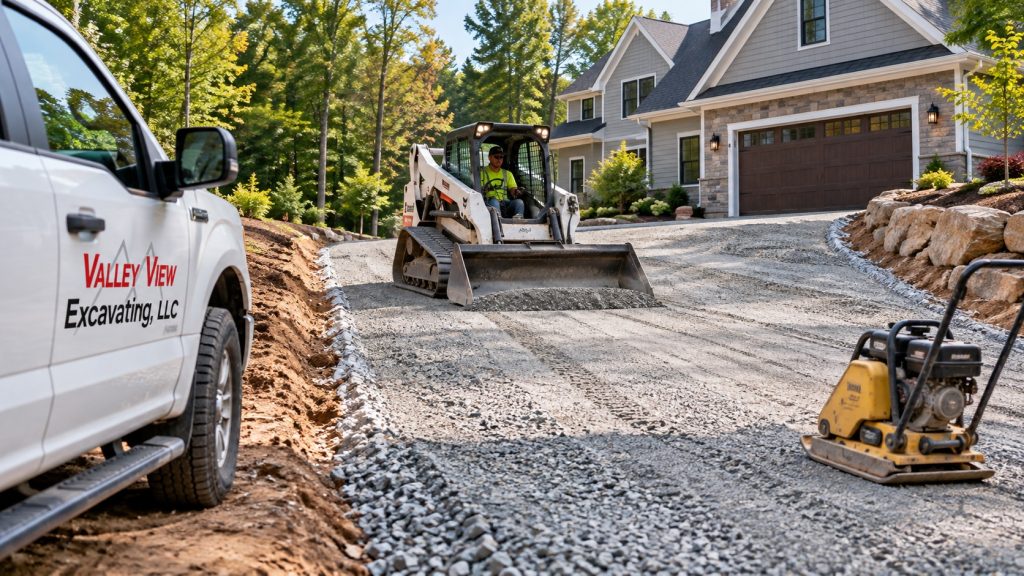
After excavating unsuitable material, we prepare the subgrade and establish a stable base.
A typical preparation sequence includes:
- Removing unsuitable material and establishing the required depth.
- Grading and compacting the underlying soil.
- Installing appropriate crushed stone or processed aggregate.
- Compacting aggregate in controlled layers.
- Checking final elevations and drainage.
Required aggregate thickness depends on soil strength, vehicle loads, and the selected driveway surface.
Explore our paving and driveway installation services to learn more about our approach to excavation and base preparation.
6. Equipment Access and Material Disposal
Limited access can increase driveway excavation costs.
Narrow entrances, retaining walls, nearby buildings, and underground utilities may restrict the equipment available.
The distance between the excavation area and disposal location also affects hauling expenses.
We consider equipment access, truck movement, and material handling when evaluating project requirements.
Driveway Excavation vs. Driveway Installation Cost
Excavation and complete driveway installation are different budget categories.
Driveway excavation generally covers removing soil, preparing the subgrade, and performing agreed-upon grading work.
Driveway installation may also include aggregate materials, drainage improvements, compaction, paving, and finishing.
Homeowners should confirm which items are included in each estimate.
For additional information about surface material pricing, read our related article, Asphalt vs. Concrete Driveway Cost Per Square Foot: 2026 Guide.
How to Reduce Driveway Site Prep Costs
Proper planning can help avoid unnecessary excavation expenses.
We recommend several practical steps:
- Finalize the driveway layout early. Changes after excavation begins can increase costs.
- Address drainage before paving. Correcting runoff problems afterward may require removing finished pavement.
- Evaluate material reuse. Suitable excavated soil may sometimes be reused elsewhere on the property.
- Provide clear equipment access. Unrestricted access can improve excavation efficiency.
- Request a detailed estimate. Confirm whether grading, hauling, aggregate, compaction, and disposal are included.
We also recommend checking local permit requirements and arranging underground utility marking before excavation begins.
Frequently Asked Questions
How much does it cost to excavate a driveway?
Straightforward driveway excavation commonly costs $1,000 to $2,500 nationally. Connecticut projects involving ledge, difficult access, or major grading may cost more.
How deep should a driveway be excavated?
Excavation depth depends on the pavement design, aggregate base requirements, soil conditions, and vehicle loads. A professional site evaluation determines the appropriate depth.
Does driveway excavation include gravel installation?
Not always. Some estimates cover excavation and grading only, while others include aggregate delivery, placement, and compaction.
Is driveway excavation necessary before repaving?
Not every repaving project requires complete excavation. However, severely deteriorated foundations, settlement, or drainage problems may require removing and rebuilding the existing base.
Get a Driveway Excavation Estimate From Valley View Excavating
A durable driveway begins with proper ground preparation.
At Valley View Excavating, LLC, we provide residential and commercial excavation, grading, and paving services throughout Plainville and surrounding Connecticut communities.
Since 2007, we’ve helped property owners prepare sites for stable, functional outdoor improvements.
Whether you’re replacing an existing driveway or preparing a new one, we’ll evaluate the property and recommend an appropriate excavation approach.
Planning to excavate a driveway? Call Valley View Excavating, LLC at (860) 559-4977 to discuss your project and request a site-specific estimate.