

Septic tank replacement in Connecticut usually begins with a site investigation, soil evaluation, percolation testing, deep observation pits, and a plan submitted to the local health department. After approval, excavation can include removing the failed tank, clearing roots, preparing the tank hole, installing the building sewer, setting the tank and distribution box, constructing the leaching system, and completing a final inspection. Connecticut septic systems serving design flows of 10,000 gallons per day or less are generally permitted by the local Director of Health.
Replacing a septic tank is not as simple as digging out one concrete structure. The tank, distribution system, soil, groundwater, drainage, and leaching area must function as one approved wastewater system.
At Valley View Excavating, we help homeowners across Hartford County and central Connecticut prepare sites for new septic systems, tank replacements, drain field repairs, and municipal sewer connections.
Signs a Septic System May Need Replacement
A professional evaluation may be needed when a property develops sewage backups, persistent drain odors, wet ground above the leaching area, unusually green grass, slow fixtures throughout the house, or wastewater surfacing in the yard.
A failed tank does not always mean the entire drain field must be replaced. The problem may involve a damaged building sewer, broken baffle, settled distribution box, clogged outlet, crushed line, or saturated leaching system. Locating the failure before excavation helps prevent unnecessary disturbance.
Connecticut identifies four basic septic components: the house sewer, septic tank, distribution system, and leaching system. Each component should be considered during replacement planning.
Perc Tests and Deep Test Pits in Connecticut
The phrase “deep perc test” is commonly used, but Connecticut separates the work into percolation test holes and deep observation pits.
A percolation test for a septic system in CT measures how quickly water moves through the receiving soil. The result helps determine the required size of the leaching system. Connecticut requires testing near the proposed leaching depth, with presoaking and timed water-level readings used to establish a uniform percolation rate.
Deep observation pits allow the local health official or engineer to evaluate:
- Soil layers and texture
- Seasonal groundwater indicators
- Ledge rock
- Restrictive soil
- Existing fill
- Roots and disturbed ground
The state requires a suitable number of test holes and observation pits in the proposed leaching area. Observation pits must extend at least four feet below the proposed leaching system bottom.
Connecticut Septic Permits and Setback Rules
Every septic plan must be submitted to the local Director of Health. The plan normally identifies the house sewer, tank size and location, leaching system, property lines, buildings, watercourses, drains, wells, and water lines. Construction approval is issued after the design is found compliant.
Setbacks depend on the site and system design. Under Connecticut’s 2024 Technical Standards, common examples include:
- 10 feet from the building served
- 50 feet from an open watercourse in standard conditions
- 15 feet from an up-gradient or side property line
- 25 feet from a down-gradient property line
- 75 feet from a low-capacity water supply well
Different site conditions, existing lots, drainage features, larger wells, coastal areas, or approved exceptions can change these distances. Final placement must follow the approved plan and local health department direction.
The Septic Drain Field Excavation Process
1. Mark Utilities and Approved Components
Before digging, the approved tank, piping, distribution box, leach lines, reserve area, property boundaries, and utilities are marked.
2. Clear the Work Area
Trees, brush, stumps, and roots may need removal where they interfere with the approved system. Heavy machinery access and soil stockpile areas are also planned before excavation begins.
3. Remove or Abandon the Old Tank
The existing tank must be pumped before removal or abandonment. Connecticut allows approved hollow components to be removed, crushed, or filled with materials such as sand, gravel, or concrete to eliminate collapse hazards.
4. Excavate and Set the New Tank
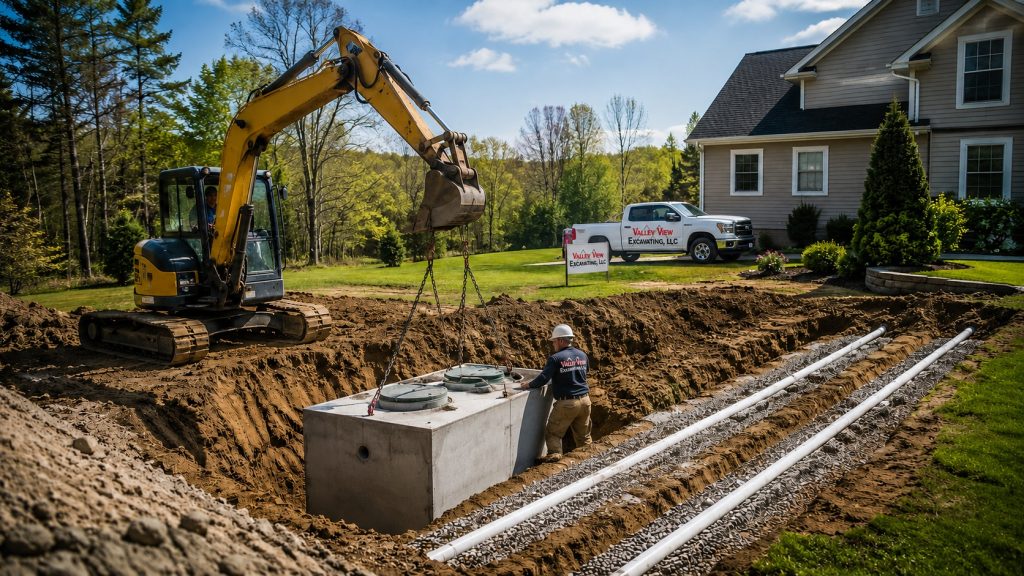
The tank hole is excavated to the approved elevation. The base must support the tank evenly, and the inlet and outlet elevations must maintain proper flow from the house toward the leaching area.
5. Install the Distribution Box
The distribution box divides septic effluent between leach lines or system rows. Careful elevation control matters because a tilted box can send too much wastewater toward one section of the field.
6. Construct the Leaching System
The crew installs approved aggregate, chambers, galleries, piping, select fill, or another specified product. Leach rows must follow the approved dimensions, spacing, elevation, and distribution method. Connecticut’s final inspection form verifies tank size, distribution-box elevations, leaching area, separation distances, materials, and plan compliance.
7. Inspection, Backfill and Restoration
Required components remain visible until the local health department completes applicable inspections. After approval, the system is backfilled and the disturbed area can be graded and prepared for seed.
Septic Tank Installation Cost in Connecticut
The septic tank installation cost in Connecticut depends on whether the project involves only the tank or a complete system replacement. Major cost factors include:
- Tank material and capacity
- Perc-test results
- Leaching-system size
- Ledge or high groundwater
- Engineered plans
- Tree and stump removal
- Excavation depth and equipment access
- Select fill and aggregate
- Pump systems or advanced treatment
- Yard restoration
Published budgeting references vary widely. Current national data places many installations around $3,600 to $12,500, while Connecticut-focused estimates commonly extend from approximately $5,000 to $30,000 when difficult soil, engineering, or full drain-field replacement is required. These figures are planning references, not project quotes.
Septic Replacement or Municipal Sewer Hookup?
A sewer hookup may be worth evaluating when municipal service is available and the property has limited room for a compliant replacement field. Sewer conversion can involve trenching, lateral installation, septic abandonment, permits, and connection to the municipal service point.
Schedule Septic Excavation in Central Connecticut
Valley View Excavating provides septic installation, removal, and replacement services for homeowners in Plainville, Hartford County, and surrounding Connecticut communities.
Contact Valley View Excavating to schedule septic excavation, tank replacement, site preparation, or a municipal sewer hookup evaluation.