
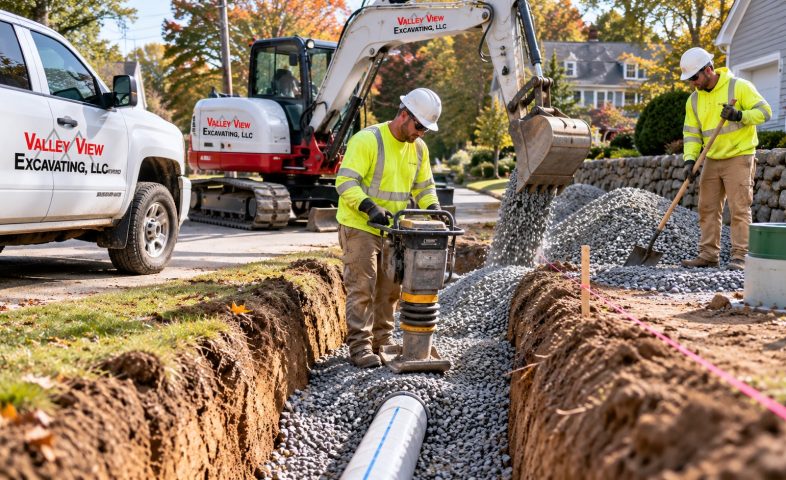
Utility trenches settle when backfill soil is inadequately compacted, placed in excessively thick layers, contains unsuitable material, or loses support through water movement. Proper trench backfill compaction involves selecting appropriate material, placing it in controlled lifts, managing moisture, and compacting each layer without damaging buried utilities. Correct installation reduces future trench settlement, pavement cracking, and costly utility trench repairs.
Why Do Utility Trenches Settle Months After Installation?
A freshly backfilled trench may look perfectly level. Months later, however, the ground above a sewer line, drainage pipe, or underground utility begins sinking.
At Valley View Excavating, LLC, we understand that excavation quality involves more than digging and covering a pipe.
The backfill must provide stable support beneath lawns, sidewalks, driveways, and other finished surfaces.
When loose material remains underground, repeated traffic loads, rainfall, and natural soil movement can gradually compress the backfill.
The result is a visible depression known as trench settlement.
In Connecticut, seasonal moisture changes and freeze-thaw cycles can make these conditions more noticeable.
5 Common Causes of Utility Trench Settlement
1. Backfill Placed in Layers That Are Too Thick
One of the most common trench backfill compaction mistakes involves filling a deep trench with several feet of soil before compacting the surface.
Compaction equipment has a limited effective depth.
The upper material may become dense while loose soil remains underneath.
Over time, this poorly compacted material compresses, causing the ground above to sink.
2. Incorrect Backfill Material
Not every excavated soil is suitable for reuse.
Organic material, construction debris, frozen soil, oversized rocks, and saturated clay can create unstable conditions.
We evaluate material suitability before recommending reuse or imported structural backfill.
Properly graded granular material often provides more predictable compaction than mixed, unsuitable excavated soil.
3. Poor Moisture Control
Moisture directly affects soil compaction.
Soil that is too dry may not compact efficiently. Excessively wet soil can deform under equipment and fail to achieve the required density.
Connecticut’s seasonal rainfall and groundwater conditions make moisture management especially important.
4. Inadequate Compaction Around Pipes
Backfill must properly support the pipe bedding and the areas beneath its sides, known as the haunches.
Poorly supported pipes can shift or deform under surrounding soil loads.
Heavy compaction equipment used too close to buried utilities can also damage piping.
We recommend following the pipe manufacturer’s installation requirements and project specifications.
5. Water Erosion or Underground Leaks
Not every trench depression results from poor compaction.
Broken drainage pipes, leaking utility connections, or uncontrolled groundwater can gradually wash fine particles from the surrounding soil.
This erosion creates underground voids that may eventually collapse.
When trench settlement develops alongside persistent wet spots, the utility itself may require inspection.
How Proper Trench Backfill Compaction Works
Successful backfilling requires a controlled process from the pipe bedding to the finished grade.
| Construction Stage | Purpose |
|---|---|
| Bedding preparation | Supports the installed pipe |
| Haunch backfill | Provides support around pipe sides |
| Initial backfill | Protects the utility from damage |
| Controlled lift placement | Prevents deep loose pockets |
| Mechanical compaction | Increases soil density and stability |
| Final grading | Establishes proper drainage and elevations |
Step 1: Prepare the Trench and Pipe Bedding
Before backfilling, we check the trench condition, utility alignment, and specified bedding requirements.
Any unstable soil beneath the pipe must be addressed before additional material is placed.
Step 2: Backfill in Controlled Lifts
Backfill should be placed in manageable layers rather than one large deposit.
Approximately 6 to 8 inches per lift is common for many structural backfill applications, although the actual thickness depends on material type, equipment, and engineering requirements.
The Federal Highway Administration’s field compaction guidance emphasizes controlled lift thickness, moisture adjustment, and appropriate compaction equipment to reduce settlement.
Step 3: Compact Each Layer Properly
We select compaction equipment based on trench width, soil properties, utility depth, and required density.
Equipment may include vibratory plates, trench rollers, or other suitable compactors.
Special care is necessary near buried pipes to avoid excessive loading or displacement.
Step 4: Verify Compaction Requirements
Some municipal and engineered projects require field density testing.
Compaction requirements vary by project. Certain specifications call for 95% of laboratory maximum dry density, but that percentage is not universal.
The approved plans determine acceptable materials, compaction percentages, and testing procedures.
Our sewer excavation services include utility excavation, backfilling, compaction, and site restoration based on project requirements.
Signs You May Need Utility Trench Repair
Property owners should watch for developing surface problems above previously excavated areas.
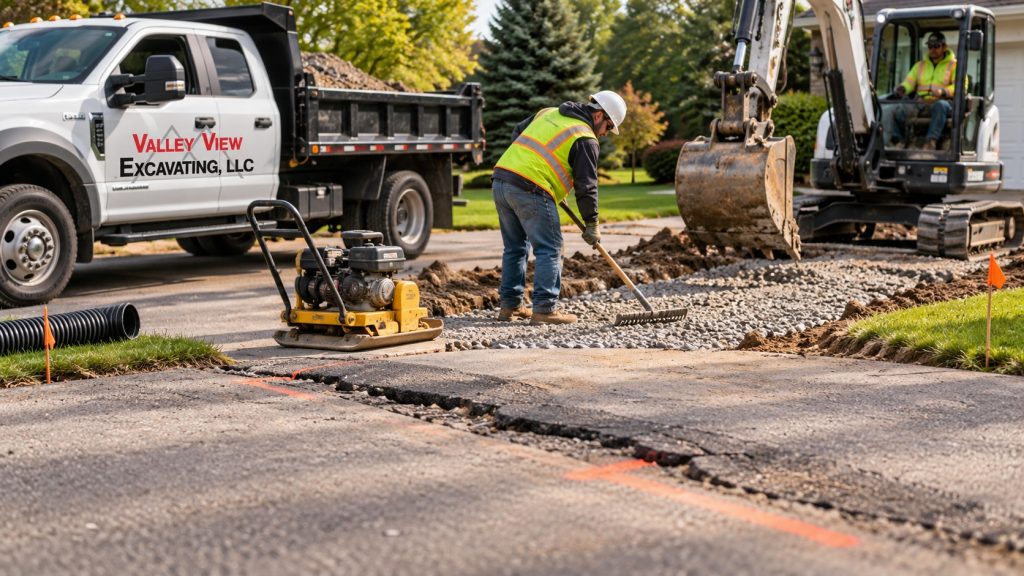
Common warning signs include sinking lawn strips, cracked asphalt, uneven sidewalks, depressions along underground utility routes, and recurring puddles.
These symptoms may indicate settlement, erosion, or damaged buried infrastructure.
We recommend evaluating the cause before simply filling the depression.
Adding topsoil or asphalt over unstable material may temporarily hide the problem without restoring structural support.
For projects involving new utility installations, explore our related guide on trenching costs per foot in Connecticut.
How Is a Settled Utility Trench Repaired?
The correct utility trench repair depends on the cause and severity.
Our evaluation may include identifying the affected utility, checking drainage conditions, locating underground lines, and determining whether soil movement is ongoing.
When defective backfill is responsible, repairs may require removing the settled material, correcting unstable areas, installing suitable replacement fill, and compacting properly before restoring the surface.
If a leaking pipe caused the settlement, the utility problem must be corrected before rebuilding the trench.
Professional excavation crews must also follow appropriate trench safety and utility-location requirements.
Frequently Asked Questions
How long does trench settlement take?
Settlement may become visible within weeks or develop over months or years. Timing depends on compaction quality, soil conditions, moisture, and surface loads.
What causes a utility trench to sink?
Common causes include loose backfill, improper lift thickness, unsuitable soil, groundwater erosion, and leaking underground pipes.
What percentage should trench backfill be compacted to?
Some engineered projects specify 95% of maximum dry density. Actual requirements depend on the applicable construction specifications and backfill material.
Can a settled trench be repaired without replacing the pipe?
Yes, when the utility remains intact. Repairs may involve excavating unstable backfill and rebuilding the trench with properly compacted material.
Prevent Costly Trench Settlement With Valley View Excavating
Proper trench backfill compaction protects underground utilities and the surfaces built above them.
At Valley View Excavating, LLC, we provide professional excavation, underground piping, grading, and site preparation services throughout Plainville and surrounding Central Connecticut communities.
Since 2007, our team has helped homeowners, contractors, and property managers complete excavation projects with careful attention to site conditions and long-term stability.
Concerned about a sinking utility trench or planning underground utility work? Contact Valley View Excavating, LLC today.