
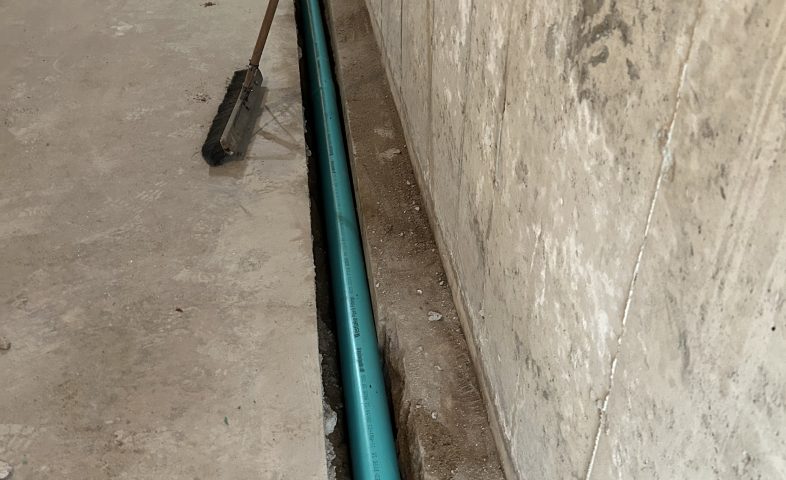
If you own a home in Connecticut, you’re no stranger to the “mud season.” However, if your backyard looks more like a pond than a lawn every time it rains, you have a subsurface drainage problem. Standing water isn’t just an eyesore; it creates a breeding ground for mosquitoes and, more importantly, puts your home at risk for hydrostatic pressure—the force that pushes water through your foundation walls.
At Valley View Excavating LLC, we specialize in permanent fixes for saturated soil. Here are the top five professional solutions for managing water runoff and protecting your property.
1. French Drains (Subsurface Water Management)
A French drain is the gold standard for basement protection. It involves digging a trench, lining it with filter fabric, and installing a perforated pipe surrounded by clean gravel.
- How it works: It intercepts groundwater before it reaches your foundation and redirects it to a lower point on your property or a dry well.
- Best For: Preventing wet basements and soggy foundation perimeters.
2. Curtain Drains
Similar to a French drain but installed further away from the house, a curtain drain acts as a “shield” for your yard.
- How it works: It’s designed to intercept “sheet flow” (surface water moving across a slope) and channel it away from your primary outdoor living spaces.
- LSI Keyword Focus: This is an essential part of landscape grading for properties situated on hills or at the bottom of a slope.
3. Catch Basins and Yard Inlets
If you have a specific low spot where water pools, a catch basin is the most effective solution.
- How it works: A grate is installed at the lowest point of the yard. Water falls into the basin, where sediment settles to the bottom, and the clear water is piped out through a solid PVC drainage line.
- Pro Tip: These are often connected to downspout extensions to ensure roof runoff is moved at least 10–20 feet away from the home.
4. Proper Grading and Sloping
Sometimes, the solution doesn’t require pipes at all. Professional yard grading involves using heavy machinery to reshape the land so that it naturally slopes away from your structures.
- The Rule of Thumb: The ground should drop at least 6 inches within the first 10 feet of your foundation.
- Why it matters: Without the correct topography, even the best drain will struggle to keep up with a heavy New England downpour.
5. Swales (Dry Creek Beds)
A swale is a wide, shallow, gravel-lined or grass-covered channel that directs water.
- The Aesthetic Choice: Many homeowners choose to turn these into “dry creek beds” using river rock and boulders, combining hardscaping with functional drainage.
- Benefit: It slows down the velocity of the water, preventing soil erosion while it moves the runoff toward a safe discharge point.
Expert Help for Your Wet Yard
Every property has a unique “watershed.” What works for your neighbor might not work for you. At Valley View Excavating, we analyze your soil type and slope to design a custom drainage and site work plan that lasts.