
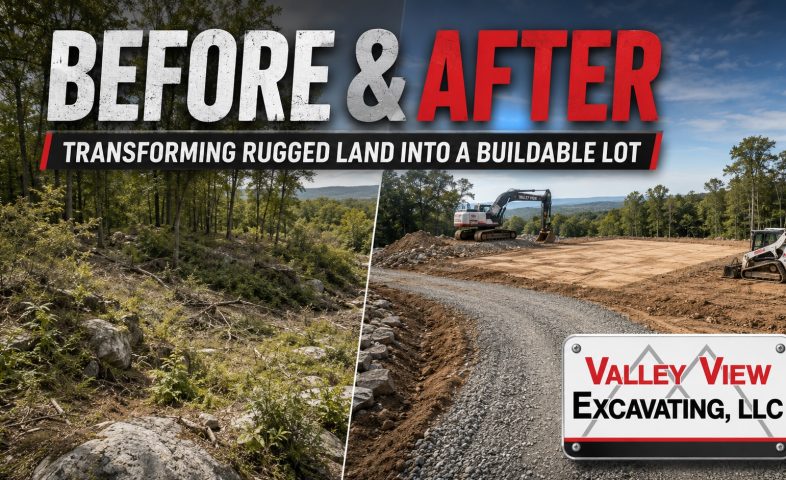
A rugged Connecticut lot becomes buildable through a controlled process: site evaluation, access planning, land clearing, erosion control, rough grading, drainage planning, utility trenching, foundation excavation, and final stabilization. In Connecticut, erosion and sediment control planning matters because construction disturbance can send runoff, sediment, and debris toward wetlands, roads, neighboring properties, and storm systems. CT guidance describes erosion and sediment control plans as a core part of construction activity planning, especially when land disturbance exceeds one half acre.
The “Before”: When Land Looks Too Rough to Build On
A wooded, rocky, sloped, or overgrown lot can look unusable at first glance. Stumps block access. Boulders sit where the driveway should go. Wet pockets collect water after rain. Brush hides grade changes. The future house location may be hard to picture.
At Valley View Excavating LLC, our work starts by reading the land before moving it. As a local Connecticut excavation company based in Plainville, we handle site preparation, grading, trenching, utility installation, foundation excavation, and land clearing for residential and commercial work.
Step 1: Walk the Lot Before the Machines Arrive
The first step is not digging. It is planning.
A proper lot evaluation looks at access, slope, soil type, tree removal needs, wet areas, ledge, utility routes, drainage patterns, and where material can be safely stockpiled. Valley View’s land clearing process starts with site evaluation, including soil type, topography, environmental constraints, preserved trees, and final construction goals.
This early phase helps answer the questions that shape the entire project:
| Site Question | Why It Matters |
|---|---|
| Where can equipment enter? | Prevents unnecessary disturbance |
| Where does water naturally move? | Protects the future foundation |
| Is there ledge or unsuitable soil? | Affects excavation time and cost |
| What trees should stay? | Preserves shade, privacy, and buffers |
| Where will utilities go? | Reduces rework later |
Step 2: Clear Only What the Build Requires
Land clearing should not mean stripping the whole lot bare. A buildable lot needs usable access, a clean work zone, and safe room for construction. It also needs smart protection around areas that should stay untouched.
On rugged Connecticut properties, that can mean removing brush, selected trees, stumps, rocks, old debris, or unstable material while protecting tree lines, neighboring boundaries, and drainage paths.
For lots with old structures, foundations, buried tanks, or contaminated soil concerns, review our guide on buried oil tanks and residential demolition in CT.
Step 3: Control Water Before It Controls the Project
Rough land usually has unmanaged water. Once clearing starts, rain can move faster across exposed soil. That is why erosion control, stabilized entrances, silt fence, sediment control, and drainage planning belong near the front of the process.
The Connecticut Construction Stormwater General Permit is designed to reduce erosion and sedimentation during and after construction through stormwater pollution control planning. CT DEEP also recognizes qualifying municipal erosion and sediment control programs for small construction projects between 1 and 5 acres.
Strong site control helps protect roads, wetlands, catch basins, and nearby properties. It also keeps the project cleaner and easier to manage.
Step 4: Rough Grade the Lot for the Future Build
Grading turns raw land into a workable construction site. This phase shapes the driveway approach, house pad, yard areas, drainage swales, and utility routes.
The goal is not just “flat.” The goal is controlled pitch. Water needs to move away from the building area, toward planned drainage points, and away from places where it could undermine the foundation, driveway, septic area, or retaining walls.
Compacted soil also has to be managed carefully. Soil compaction reduces pore space, which lowers water infiltration and drainage. That matters because a future yard, foundation perimeter, driveway base, or septic area can fail when water cannot move correctly.
Step 5: Prepare for Utilities, Foundation, and Access
Once the lot is cleared and rough graded, the buildable layout becomes easier to see. This stage often includes trenching for utilities, shaping a driveway base, preparing the foundation excavation, and creating safe equipment access.
For a home build, the most valuable “after” is not just a cleared property. It is a site where the builder can work efficiently. Footing areas are accessible. Utilities have planned routes. Drainage has a direction. Material stockpiles are controlled. Trucks can enter and exit without tearing up the entire site.
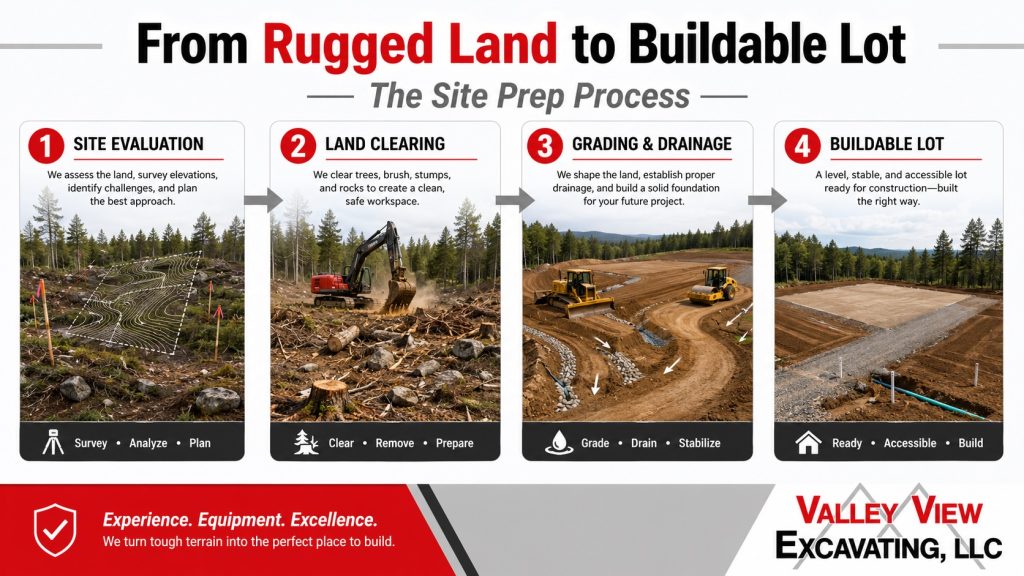
The “After”: What a Buildable Lot Should Look Like
A properly transformed lot should have:
- A defined driveway or construction entrance
- Cleared and accessible building area
- Rough grading that supports drainage
- Protected boundaries and no-work zones
- Stabilized soil where construction is complete
- Utility routes planned or installed
- Foundation area ready for the next trade
- Drainage problems addressed before the build begins
Healthy soil and stabilized surfaces also reduce runoff risk. NRCS notes that healthy soils absorb and retain more water, making them less vulnerable to runoff and erosion.
Buildable Starts Below the Surface
Transforming rugged land into a buildable lot takes more than clearing trees. It takes planning, grading, drainage awareness, erosion control, utility coordination, and clean excavation work.
At Valley View Excavating LLC, our team helps Connecticut property owners move from raw land to construction-ready site prep with practical planning and careful equipment work. Whether the lot needs clearing, grading, trenching, drainage correction, foundation excavation, or retaining wall support, our goal is simple: make the land ready for what comes next.
Start with Valley View Excavating LLC for excavation services, yard drainage, retaining walls, and complete site preparation across Plainville and surrounding Connecticut towns.