
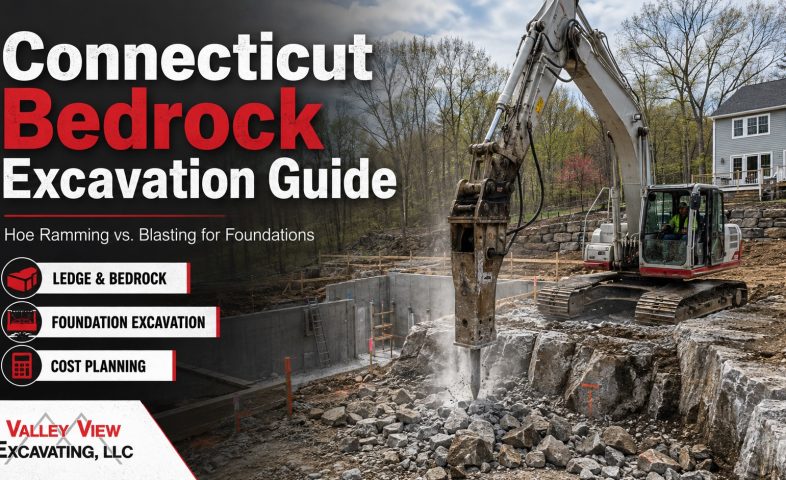
Excavating through bedrock in Connecticut can turn a routine foundation, addition, sewer line, or utility trench into a specialized rock-removal project. Connecticut DEEP notes that bedrock is a predominant geologic feature across much of the state, with many upland properties having relatively thin glacial soils over rock. When ledge is encountered, contractors generally evaluate whether an excavator-mounted hydraulic hammer, commonly called hoe ramming, can break the rock efficiently or whether controlled blasting is justified for a larger, harder formation. Blasting carries additional licensing, permitting, utility-location, vibration, and site-control requirements. Because rock type, depth, access, disposal, equipment size, and volume vary dramatically, there is no dependable statewide rock excavation cost per cubic yard that fits every property.
At Valley View Excavating, LLC, we approach heavy-rock excavation by determining what is below the surface, how much material must come out, and which removal method makes the most sense before foundation work moves forward.
Why Connecticut Excavation Often Hits Ledge
Connecticut construction sites can change quickly once topsoil, fill, and glacial till are removed.
The Connecticut Geological Survey maintains statewide bedrock and surficial-material maps because subsurface conditions vary considerably from one part of the state to another. Those maps can help with preliminary planning, but actual excavation conditions still need to be evaluated at the property.
Homeowners commonly encounter ledge during:
- New home foundation excavation
- Basement additions
- Garage foundations
- Sewer and water trenches
- Septic installations
- Drainage work
- Retaining wall construction
- Deep utility installation
A project that looks like ordinary soil excavation from the surface may expose solid or fractured rock several feet down.
For broader foundation-site preparation, see our Plainville excavation contractor services.
What Happens When an Excavator Hits Bedrock?
The first step is determining whether the material is loose boulder, weathered rock, fractured ledge, or competent bedrock.
Loose rock may be removed with a standard excavator bucket. More solid formations can require a hydraulic breaker.
The excavation crew also needs to determine:
- How much rock interferes with the required elevation
- Whether the rock can remain beneath portions of the structure
- How close neighboring foundations, utilities, wells, roads, or septic components are
- Whether broken rock can remain on site or must be hauled away
- Whether mechanical removal remains practical as excavation progresses
That assessment is especially important on deep foundation digs because removing several inches of ledge is very different from lowering an entire basement footprint several feet.
Hoe Ramming vs. Blasting a Foundation
Both methods can remove bedrock, but they solve different site problems.
Hoe Ramming
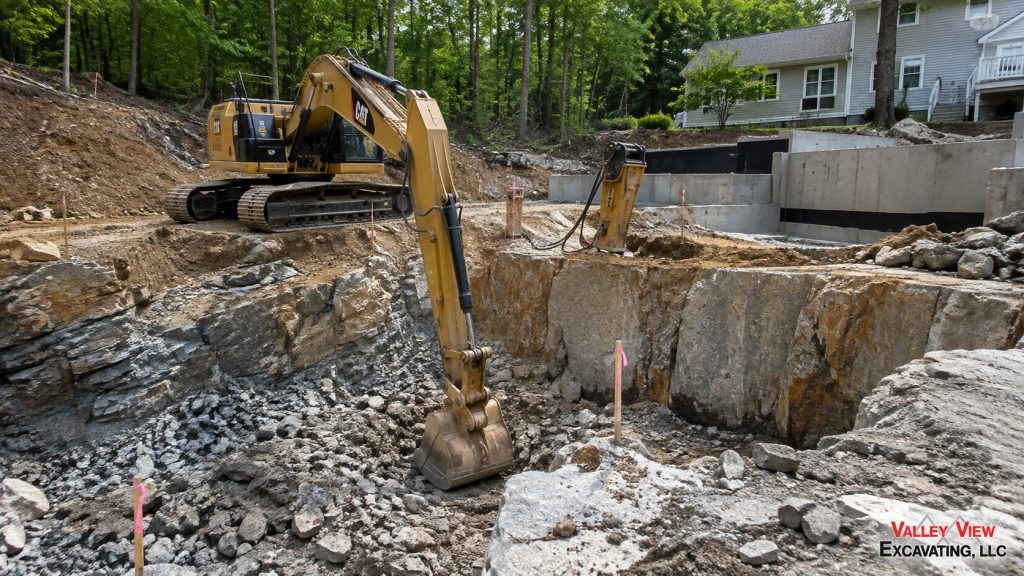
Hoe ramming uses a hydraulic breaker mounted on an excavator. The hammer repeatedly fractures exposed rock so the excavator can remove the broken pieces.
We generally look at mechanical breaking when the rock volume is manageable or when precision matters around existing structures.
Advantages include:
- Controlled removal in specific areas
- No explosives
- Good access to narrow foundation sections
- Ability to stop at the required elevation
- Practical for trenches and isolated ledge
The tradeoff is production rate. Extremely hard, massive bedrock can require many hours of hammering, increasing equipment time, fuel, labor, and wear.
Controlled Blasting
For a large volume of competent bedrock, blasting can sometimes fragment more rock in less time.
That does not mean blasting is automatically cheaper.
Connecticut law regulates the storage, transportation, and use of explosives. A person using explosives must meet applicable licensing and written permit requirements, and excavation or blasting work must account for underground utility locations before proceeding.
Blasting may also require additional planning involving nearby structures, vibration concerns, access control, drilling, mats, inspections, and rock removal after the blast.
For homeowners comparing hoe ramming vs blasting for a foundation, the better method is usually the one that produces the required excavation safely and efficiently for that particular site.
How Much Does Rock Excavation Cost per Cubic Yard?
Searching for a single rock excavation cost per cubic yard can be misleading.
Unlike ordinary soil, one cubic yard of fractured ledge may require little additional work, while the same volume of dense bedrock may require extensive hammering or drilling.
Major cost factors include:
| Cost Factor | Why It Matters |
|---|---|
| Rock hardness | Harder rock takes longer to fracture |
| Total volume | Larger quantities can change equipment strategy |
| Excavation depth | Deep work can reduce production efficiency |
| Site access | Tight residential lots limit machine size |
| Hammer size | Larger breakers generally require larger excavators |
| Hauling | Broken rock can add trucking and disposal costs |
| Blasting requirements | Drilling, permits, safety controls, and specialists add cost |
| Nearby structures | Precision and vibration management can affect the method |
A better estimate separates normal excavation from a rock allowance or contingency. That makes it easier to see how the budget changes if ledge appears.
Can Bedrock Be Predicted Before Digging?
Sometimes, but not perfectly.
Visible outcroppings, neighboring construction records, test pits, borings, and geologic mapping can all provide clues.
Connecticut DEEP publishes statewide and quadrangle-level geologic information that can help property owners understand the broader geology around a proposed construction site.
View Connecticut DEEP geologic maps
For larger projects where elevation tolerances are critical, test excavation or geotechnical investigation may be worth completing before the final construction budget is established.
Plan for Rock Before the Foundation Crew Arrives
Unexpected ledge becomes most expensive when it disrupts an already tight construction schedule.
We recommend discussing rock contingencies before excavation begins, including equipment access, potential hammering, hauling locations, foundation elevations, drainage, and what happens if the rock volume exceeds the original assumption.
Our related guide, What to Expect When Excavating a Full Concrete Basement, explains how excavation, footing preparation, backfill, and grading fit into the larger foundation process.
Heavy-Rock Foundation Excavation in Connecticut
Excavating through bedrock requires more than a larger excavator. The crew needs to understand rock behavior, machine capability, elevations, access, utilities, drainage, hauling, and the point where mechanical breaking may no longer be the most efficient option.
At Valley View Excavating, LLC, we handle complex excavation for Connecticut foundations, additions, trenches, drainage projects, and site work. When ledge appears, our goal is to build a practical rock-removal plan that keeps the excavation accurate while controlling avoidable equipment time and project delays.
Planning a foundation or deep excavation where ledge may be present? Contact Valley View Excavating, LLC for a site evaluation and rock-excavation estimate before construction begins.