

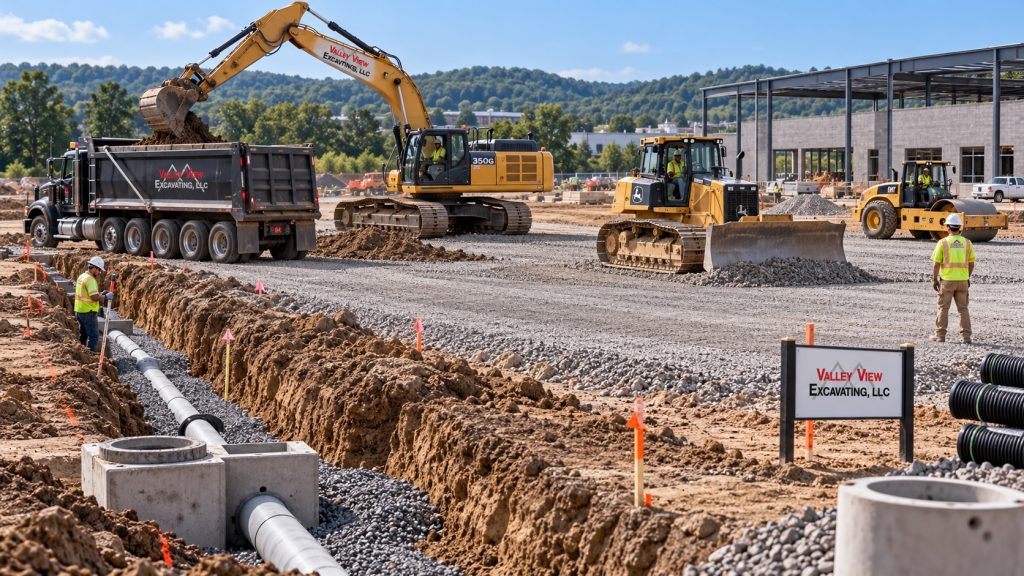
Commercial site preparation turns raw or previously developed land into a stable, properly graded construction platform. For projects across Central Connecticut, we typically coordinate clearing, mass excavation, cut-and-fill operations, building-pad grading, utility trenches, drainage structures, aggregate subbase placement, and controlled compaction. The goal is to deliver elevations, drainage, utility access, and bearing conditions that allow foundation, paving, concrete, and utility crews to keep moving. Valley View Excavating, LLC handles both residential and commercial excavation site work from Plainville and has experience with underground piping, parking lots, storm drainage, sewer and water infrastructure, and other excavation projects.
For general contractors, developers, and commercial property managers, that below-grade work can determine whether the rest of the schedule runs smoothly.
Commercial Site Prep Starts With Mass Grading
Mass grading is much more than making a parcel look flat.
We use grading to establish the elevations called for in the site plan while controlling where stormwater moves. Depending on the property, that can require cutting high areas, filling low areas, exporting unsuitable material, importing structural fill, and constructing building pads, roadways, parking areas, and drainage swales.
A typical mass-grading sequence may include:
- Clearing vegetation, debris, and unsuitable surface material
- Stripping and stockpiling usable topsoil
- Excavating high areas to planned elevations
- Filling low areas in controlled lifts
- Establishing building and pavement subgrades
- Creating temporary and permanent drainage
- Preparing areas for utility installation
- Fine grading before the next construction phase
For site grading contractors in Plainville, accuracy matters because a grading error can affect foundations, parking-lot drainage, sidewalks, utilities, and finished elevations.
Our Plainville excavation contractor services support commercial, municipal, and residential projects requiring professional excavation and site development.
Cut-and-Fill Planning Can Control Project Costs
Moving earth around the same site is usually more efficient than hauling unnecessary loads off site and purchasing replacement fill.
Before major earthwork begins, we evaluate how excavation and fill areas relate to the proposed elevations. That helps determine whether excavated material may be reused or whether unsuitable soils need removal.
Potential problem materials can include:
- Organic soil
- Buried construction debris
- Saturated soil
- Soft subgrade
- Loose undocumented fill
- Large rock or ledge
- Material that cannot meet project compaction requirements
Correcting weak material before foundations or pavement are installed reduces the risk of settlement later.
Utility Trenching Requires Coordination Before the Bucket Moves
Commercial sites can contain water, sewer, storm drainage, electrical conduit, telecommunications, gas, and other underground infrastructure.
For utility trenching contractors in Hartford County, excavation accuracy affects both safety and the crews following behind.
Our trenching process considers:
- Utility layout and verified underground locations
- Required trench depth and width
- Existing soil conditions
- Pipe or conduit bedding requirements
- Groundwater and drainage
- Trench protection requirements
- Backfill material
- Compaction around and above utilities
OSHA requires pre-job planning around existing utilities and soil conditions. Trenches 5 feet deep or greater generally require a protective system unless the excavation is entirely in stable rock, and a competent person must evaluate excavation conditions and appropriate protection.
Safety and production have to work together. A poorly planned trench can delay utility installation, create unstable conditions, or force finished work to be excavated again.
Why Utility Backfill Matters
Installing the pipe is only part of the job.
Utility trenches beneath roads, parking lots, sidewalks, or building areas must be backfilled properly so the trench does not become a future settlement zone.
Dumping several feet of material into a trench and compacting only the surface can leave loose soil below.
We instead work around project specifications by placing approved material in controlled lifts and compacting each lift with equipment suited to the trench width and soil type.
That creates a more uniform base for whatever comes next.
Subbase Compaction Protects Pavement and Concrete
A commercial parking lot can have premium asphalt and still fail if the material underneath moves.
Strong subbase preparation starts by exposing competent subgrade and correcting soft areas. Depending on the design, we may then install processed aggregate or specified structural fill in multiple compacted lifts.
Important steps can include:
- Proof-rolling exposed subgrade
- Excavating soft or pumping areas
- Moisture-conditioning fill when necessary
- Placing aggregate at controlled thicknesses
- Compacting each lift
- Checking elevations and slopes
- Coordinating density testing when specified
Required compaction percentages and lift thicknesses should follow the project’s geotechnical recommendations and construction specifications rather than a single rule used on every property.
The same principle applies to foundations, loading areas, dumpster pads, sidewalks, and other hard surfaces.
Drainage Must Be Built Into Commercial Site Work
Water management starts during earthwork, not after paving.
Commercial grading may incorporate catch basins, storm piping, swales, culverts, detention features, stone drainage zones, and temporary erosion-control measures.
Our existing guide to commercial site preparation in Central Connecticut covers additional considerations such as erosion control, rock handling, construction entrances, sediment control, and final grading.
Proper drainage protects the subgrade while construction is underway and helps preserve the completed property afterward.
Commercial Excavation Contractor for Central Connecticut Projects
At Valley View Excavating, LLC, we approach commercial site work in CT as a coordinated system.
Mass grading affects utilities. Utilities affect trench backfill. Backfill affects pavement. Drainage affects nearly every phase.
Our excavation capabilities include commercial site work, underground piping, sewer and water excavation, storm drainage, grading, parking-lot preparation, demolition, and related earthwork. Valley View has served Plainville and surrounding Connecticut communities since 2007.
General contractors, developers, property managers, and commercial owners can contact our team to discuss excavation scope, site conditions, scheduling, and equipment requirements before construction begins.
Plan Your Central CT Site Work
Need a commercial excavation contractor in CT for grading, utility trenching, subbase preparation, or complete site development?
Contact Valley View Excavating, LLC to review the plans and prepare the site for the next phase of construction.