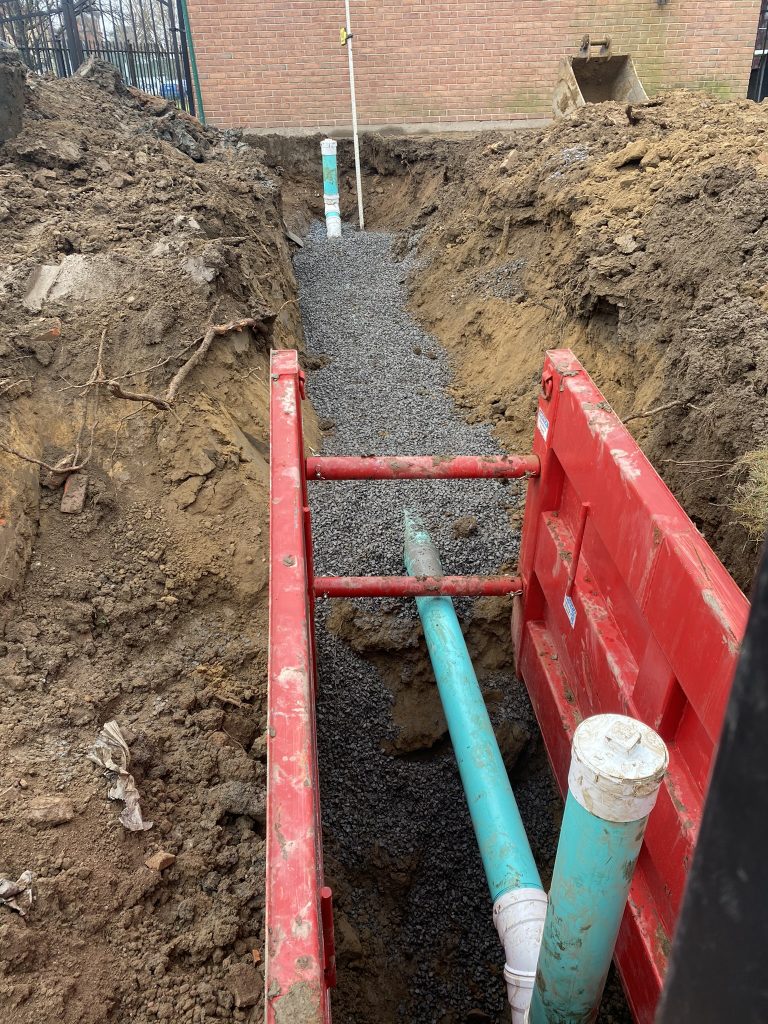
A sewer excavation contractor exposes underground sewer pipes so damaged sections can be repaired, replaced, realigned, or newly installed. Open-cut excavation is often required when a sewer line has collapsed, developed major offsets, lost its proper slope, or contains damage that cannot be corrected through cleaning or pipe lining. EPA guidance confirms that open-cut repair allows a damaged pipe section to be removed, replaced, and reconnected to structurally sound piping.
At Valley View Excavating, we provide professional sewer line excavation for homes, businesses, municipalities, and property managers in Plainville and surrounding Connecticut communities. We handle sewer line repair, sewer lateral replacement, new sewer installation, and excavation for broken or collapsed underground pipes.
Complete Sewer Line Excavation Services
Sewer problems can quickly affect toilets, drains, basements, yards, and commercial operations. Our team evaluates the condition and location of the underground line before recommending excavation.
Our sewer excavation services include:
- Broken sewer pipe repair
- Sewer lateral excavation
- Complete sewer line replacement
- Targeted sewer spot repair
- New sewer line installation
- Collapsed sewer line excavation
- Root-damaged pipe replacement
- Sewer connection excavation
- Residential sewer excavation
- Commercial sewer excavation
- Emergency sewer line repair
- Excavation for improperly pitched pipes
We select the excavation approach based on the pipe depth, soil conditions, access, nearby utilities, surface materials, and extent of damage.
When Is Sewer Excavation Necessary?
Not every slow drain requires digging. Cleaning or sewer maintenance may restore flow when grease, wipes, debris, or minor tree root intrusion causes a blockage. Excavation becomes more likely when the line has a structural failure.
Common reasons for sewer excavation include:
- A fully or partially collapsed sewer pipe
- Cracked clay, cast iron, Orangeburg, or PVC piping
- Separated or offset pipe joints
- Severe tree root intrusion
- Repeated sewage backups
- A low spot or belly holding wastewater
- Incorrect sewer pipe slope
- Soil entering through a broken section
- A failed connection at the sewer main
- Damage caused by settling or ground movement
EPA guidance separates localized repair, rehabilitation, and complete replacement based on the condition of the existing sewer. Replacement installs a new pipe that does not depend on the damaged host pipe for structural support.
Property owners comparing excavation with trenchless methods can review our sewer line repair options.
Our Sewer Excavation Process
1. Evaluate the Sewer Problem
We begin by reviewing the symptoms, property layout, available inspection findings, and known sewer route. Camera inspection results can help identify cracks, offsets, roots, standing wastewater, or collapsed sections.
2. Locate Underground Utilities
Utility locating is an essential step before mechanized excavation. Connecticut’s Call Before You Dig program requires a locate request before qualifying excavation begins, including work performed on private property.
3. Plan the Excavation Area
We determine the safest and most practical location for accessing the failed sewer line. The plan considers pipe depth, soil stability, groundwater, buildings, driveways, patios, landscaping, and nearby underground utilities.
4. Expose and Repair the Pipe
Our crew carefully excavates to the sewer line, removes damaged material, and prepares the area for spot repair, reconnection, realignment, or full sewer pipe replacement.
5. Test and Restore the Site
After the repair or installation is complete, the sewer line is checked for proper flow and connection. We then backfill, compact, and restore the disturbed area based on the project scope.
Safety-Focused Sewer Trenching
Sewer excavation requires more than operating heavy equipment. Trench depth, soil type, water conditions, utility locations, access, and protective systems must all be considered.
OSHA identifies cave-ins as the greatest danger during trenching operations and recognizes sloping, shoring, and shielding as primary protective methods. Safe access, proper inspections, water control, and keeping excavated material away from trench edges are also important.
Our team approaches each sewer trench with careful planning and equipment suited to the site.
Sewer Line Repair or Complete Replacement
A targeted excavation may be enough when only one short section has failed. Complete sewer line replacement may provide better long-term value when the pipe contains widespread cracking, several offsets, extensive root intrusion, poor slope, or deteriorated materials.
We evaluate the entire situation before recommending how much pipe should be exposed or replaced. Our goal is to complete the necessary work without creating unnecessary disturbance.
What Affects Sewer Excavation Cost?
Sewer line excavation cost varies according to:
- Pipe depth and total excavation length
- Location of the damaged sewer section
- Soil, ledge, and groundwater conditions
- Residential or commercial site access
- Number of damaged pipe sections
- Driveway, pavement, patio, or lawn restoration
- Permits and municipal requirements
- Emergency or scheduled excavation
- Sewer pipe material and diameter
EPA guidance notes that open-cut repair costs and disruption can increase when a sewer is deep, below groundwater, beneath pavement, or located in a heavily traveled area.
Why Choose Valley View Excavating?
Valley View Excavating has served Plainville and surrounding communities since 2007. Our company has completed extensive sewer line excavation work, including municipal sewer projects trusted to us by the Town of Plainville.
Our listed Connecticut credentials include HIC #0616178, PLM #0284325-P7, and Sub-Surface Sewage Installer #6151.
We bring experienced operators, appropriate excavation equipment, careful site planning, and direct communication to residential and commercial sewer projects.
Sewer Excavation Contractor FAQs
How do contractors locate a broken sewer line?
Contractors may use sewer camera findings, electronic locating equipment, property plans, cleanouts, visible symptoms, and site measurements to identify the pipe route and damaged section.
Can only one section of a sewer line be excavated?
Yes. A spot excavation may be appropriate when the damage is isolated and the remaining sewer pipe is structurally sound.
Who is responsible for the sewer lateral?
Responsibility depends on the municipality. In many Connecticut communities, the property owner is responsible for the sewer lateral connecting the building to the municipal sewer main.
Request Sewer Excavation in Plainville, CT
Recurring sewage backups, foul odors, wet areas, and multiple slow drains may indicate an underground sewer failure. Contact Valley View Excavating or call (860) 559-4977 to request an assessment from a sewer excavation contractor serving Plainville and surrounding Connecticut towns.