

Construction dewatering is the process of removing or lowering groundwater and accumulated water so excavation work can proceed safely. Common methods include sump pumping, wellpoint systems, deep wells, eductor systems, and groundwater cutoff barriers. The appropriate method depends on excavation depth, soil permeability, groundwater levels, and pumping requirements. In Connecticut, groundwater control is especially important for foundation excavation, sewer installation, utility trenching, and commercial site preparation. Proper dewatering helps maintain soil stability, protect workers, and prevent construction delays.
What Is Construction Dewatering?
Groundwater can become a major obstacle during construction, especially when excavation extends below the natural water table.
At Valley View Excavating, LLC, we help property owners and contractors throughout Plainville and Central Connecticut prepare sites for foundations, underground utilities, and commercial development.
When groundwater enters an excavation, it can soften exposed soil, interfere with equipment, and create unsafe working conditions.
Construction dewatering helps control these conditions by removing accumulated water or lowering groundwater before and during excavation.
However, simply pumping water out of a hole is not always enough.
Effective groundwater management requires understanding how water moves through the surrounding soil and selecting appropriate control methods.
Why Is Dewatering Important During Excavation?
Uncontrolled groundwater creates several construction challenges.
1. Excavation Wall Instability
Saturated soil can lose strength, increasing the risk of trench wall collapse.
Proper water management works alongside required shoring, sloping, or shielding systems.
2. Unstable Foundation Subgrades
Excessive groundwater can soften foundation soils and interfere with proper grading, compaction, and concrete preparation.
3. Construction Delays
Water-filled excavations can delay utility installation, foundation work, and equipment access.
4. Soil Erosion and Sediment Movement
Pumping water without appropriate controls may carry soil particles away, potentially destabilizing the excavation or creating sediment discharge problems.
5. Equipment and Access Problems
Mud, standing water, and saturated ground can reduce equipment stability and make construction access more difficult.
5 Common Construction Dewatering Methods
Different excavation conditions require different groundwater control techniques.
1. Sump Pump Dewatering
Sump pumping is one of the simplest methods for removing accumulated water.
Water is directed toward a designated low point or sump pit, where a pump collects and removes it.
Best Applications:
- Shallow excavation projects
- Rainwater accumulation
- Limited groundwater seepage
- Small foundation excavations
Sump pumping is relatively straightforward, but it may be unsuitable where uncontrolled seepage can undermine excavation walls or cause soil particles to wash away.
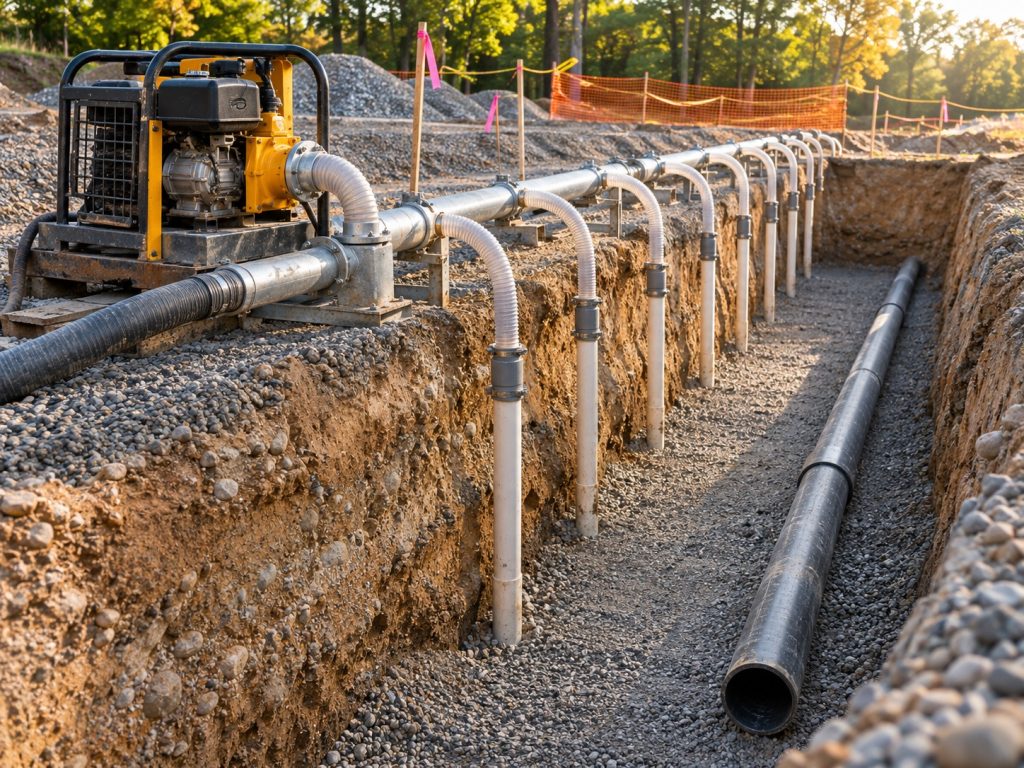
2. Wellpoint Dewatering Systems
Wellpoint systems use multiple small wells installed around an excavation.
These wells connect to a common header pipe and pumping system that lowers groundwater levels before water reaches the excavation.
Best Applications:
- Utility trench dewatering
- Excavations in suitable sandy soils
- Shallow to moderately deep groundwater control
- Sites requiring continuous groundwater lowering
Wellpoint systems often require specialized installation and careful monitoring.
3. Deep Well Dewatering
Deep well systems use drilled wells equipped with submersible pumps.
They can lower groundwater levels over larger areas or greater depths than conventional suction-based wellpoints.
Best Applications:
- Deep foundation excavations
- Large construction sites
- Highly permeable groundwater-bearing soils
- Projects requiring significant groundwater drawdown
Deep wells typically require engineering evaluation to determine pumping capacity, well spacing, and potential effects on nearby properties.
4. Eductor Dewatering Systems
Eductor systems use pressurized water and specialized pumping equipment to draw groundwater from installed wells.
These systems can be useful where soils transmit water slowly and conventional pumping methods are ineffective.
Best Applications:
- Deep excavations in lower-permeability soils
- Sites with limited groundwater flow
- Projects requiring groundwater lowering beyond practical suction limits
Eductor systems are specialized and generally require professional groundwater engineering.
5. Groundwater Cutoff Barriers
Instead of relying entirely on pumping, some projects use physical barriers to limit groundwater entering the excavation.
Methods may include sheet piles, slurry walls, or other engineered cutoff systems.
Best Applications:
- Excavations near existing structures
- Sites requiring reduced groundwater inflow
- Large commercial or infrastructure projects
- Locations where excessive pumping could affect surrounding ground
Cutoff barriers often work alongside pumping equipment rather than replacing dewatering completely.
Construction Dewatering Methods Compared
| Method | Typical Application | Main Consideration |
|---|---|---|
| Sump pumping | Shallow excavations | Controls collected water |
| Wellpoints | Trenches and sandy soils | Lowers groundwater before entry |
| Deep wells | Deep, large excavations | Requires suitable aquifer conditions |
| Eductors | Lower-permeability soils | Specialized equipment |
| Cutoff barriers | Restricted groundwater inflow | Engineered installation |
The correct approach depends on actual ground conditions rather than excavation size alone.
How Connecticut Soil Conditions Affect Dewatering
Connecticut construction sites can contain combinations of glacial till, sand, gravel, clay, and shallow bedrock.
These materials influence how groundwater enters an excavation.
Sandy and Gravelly Soil: Water may move quickly, requiring continuous pumping or groundwater lowering.
Clay and Dense Till: Groundwater may move slowly, but accumulated water can still soften exposed soil.
Shallow Bedrock: Groundwater may travel along fractures or collect above less-permeable rock layers.
At Valley View Excavating, we consider soil conditions, underground utilities, site access, and drainage when planning excavation work.
Our excavation services in Plainville, CT support residential and commercial projects involving grading, underground piping, and site development.
Construction Dewatering Safety Requirements
Groundwater control is an important part of excavation safety.
OSHA Standard 29 CFR 1926.651(h) prohibits employees from working in excavations containing accumulated or accumulating water unless adequate protective precautions have been implemented.
When water removal equipment is used, a competent person must monitor its operation.
We recommend evaluating:
- Soil and trench stability
- Groundwater inflow rates
- Appropriate protective systems
- Pump operation and backup arrangements
- Safe access and exit
- Nearby underground utilities
- Discharge and erosion controls
Removing visible water does not automatically make an excavation safe to enter.
Connecticut Dewatering Permits and Discharge Requirements
Construction dewatering also requires appropriate water discharge management.
The Connecticut Department of Energy and Environmental Protection administers the Dewatering and Remediation General Permit, updated in 2026.
Depending on the project, water quality, discharge location, and applicable permit coverage, registration, treatment, monitoring, or other approvals may be necessary.
Sediment-laden or contaminated water should not be discharged into storm drains, wetlands, or waterways without the required authorization and controls.
For broader site preparation considerations, read our related article, Commercial Site Work in Central CT: Mass Grading, Utility Trenching & Subbase Compaction.
Frequently Asked Questions
What is the purpose of construction dewatering?
Construction dewatering removes or lowers groundwater to support excavation stability, improve working conditions, and allow underground construction activities to proceed.
What is the best dewatering method for trenches?
Sump pumps may work for limited water accumulation, while wellpoint systems may be appropriate for trenches affected by continuous groundwater inflow.
Can excavation continue when groundwater is present?
Yes, when appropriate protective measures, groundwater controls, and required inspections are in place. Unsafe water accumulation must be addressed before workers enter.
Does every construction project require dewatering?
No. Dewatering becomes necessary when groundwater or accumulated surface water interferes with safe excavation and construction activities.
Plan Your Excavation Project With Valley View Excavating, LLC
Effective construction dewatering begins with understanding the site, soil conditions, groundwater behavior, and excavation requirements.
At Valley View Excavating, LLC, we provide residential and commercial excavation, site preparation, underground piping, grading, and drainage-related earthwork throughout Plainville and surrounding Connecticut communities.
Since 2007, we’ve helped property owners and contractors prepare sites for successful construction projects.