
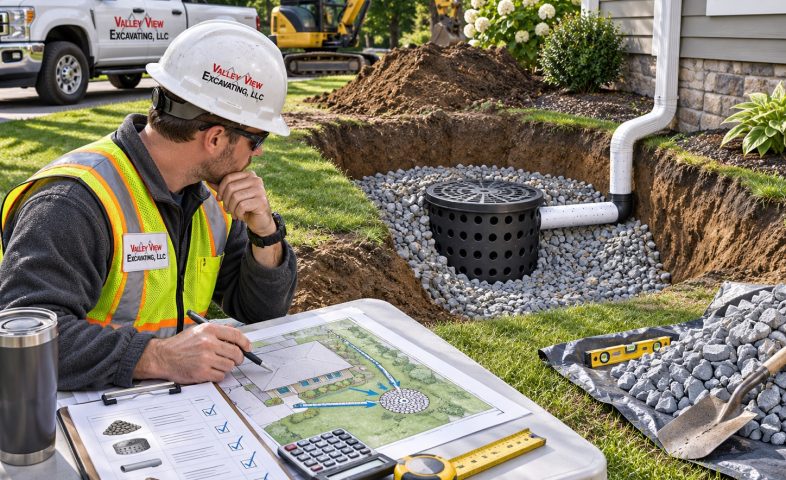
Dry well installation costs typically range from $1,334 to $5,139 nationally in 2026, with an average of approximately $3,110. Connecticut homeowners may pay more or less depending on excavation depth, soil conditions, drainage pipe length, system capacity, and site accessibility. Small gravel systems generally cost less than prefabricated plastic or concrete dry wells. Properties with clay-heavy soil, shallow bedrock, or difficult excavation conditions may require additional work.
How Much Does a Dry Well Cost in Connecticut?
Standing water, soggy lawns, and overflowing downspouts can create serious drainage problems around residential properties.
A properly designed dry well provides underground storage for stormwater, allowing collected water to gradually soak into suitable surrounding soil.
At Valley View Excavating, LLC, we help homeowners throughout Plainville and surrounding Connecticut communities evaluate drainage problems and determine which solutions are appropriate.
According to Angi’s 2026 dry well installation cost guide, professional installation averages approximately $3,110 nationally, with most projects ranging from $1,334 to $5,139.
However, these are national estimates, not guaranteed Connecticut contractor prices.
The actual dry well cost depends on what must be excavated, how much water needs to be managed, and whether the soil can absorb that water effectively.
Dry Well Installation Cost Breakdown
Different dry well systems have different material and installation requirements.
| Dry Well Type | Typical Material Cost | Description |
|---|---|---|
| Gravel dry well | $50 to $250 | Simple stone-filled infiltration pit |
| Prefabricated plastic | $90 to $650 | Underground drainage chamber |
| Precast concrete | $300 to $4,500+ | Larger, heavy-duty infiltration structure |
These are national material-only estimates. Excavation, piping, labor, testing, permits, and landscape restoration are additional expenses.
For complex projects involving large concrete systems or difficult excavation, total installation costs can exceed $10,000.
6 Factors That Affect Dry Well Installation Cost
1. Dry Well Size and Storage Capacity
The amount of stormwater entering the system determines how much underground storage is required.
A dry well collecting runoff from one residential downspout may be substantially smaller than a system managing several roof sections.
We evaluate the contributing drainage area and anticipated runoff before recommending a system size.
An undersized dry well may fill too quickly during heavy rainfall.
2. Soil Drainage and Infiltration Rates
Soil permeability is one of the most important considerations.
A stormwater dry well works by allowing collected water to infiltrate the surrounding ground.
Sandy or well-draining soils can support infiltration more readily than dense clay.
Some Connecticut properties contain compacted soils, glacial deposits, or high seasonal groundwater levels that limit drainage.
We recommend evaluating infiltration conditions before installing underground storage.
A system that cannot drain between storms may provide little long-term benefit.
3. Excavation Depth and Ground Conditions
Excavation represents a significant portion of many dry well installation projects.
Connecticut properties can contain buried boulders, shallow ledge, compacted soil, and underground utilities.
These conditions may require specialized equipment, additional labor, or changes to the installation design.
At Valley View Excavating, we evaluate access and ground conditions before determining excavation requirements.
4. Drainage Pipe Length
A dry well often receives stormwater through underground piping.
For example, rainwater collected from a downspout may travel through buried solid pipe before entering the dry well.
Longer piping routes require additional trenching, materials, backfill, and restoration.
Projects involving multiple downspouts, catch basins, or changes in elevation may cost more than a simple single-inlet installation.
5. Permits and Soil Testing
Some Connecticut drainage projects require municipal approvals or additional site evaluations.
Local regulations, property boundaries, groundwater protection requirements, and proximity to foundations can influence where a dry well may be installed.
We recommend verifying local requirements before beginning excavation.
Infiltration testing may also be necessary to determine whether the proposed location can absorb the expected runoff.
6. Landscape Restoration
Installing a dry well may disturb existing grass, planting beds, walkways, or other landscaping.
Restoring the affected area can involve:
- Backfilling and soil compaction
- Final grading
- Topsoil placement
- Grass seeding or sod
- Hardscape repairs
The amount of restoration required should be included in the installation estimate.
Is a Dry Well Worth the Cost?
A dry well can be a practical long-term drainage solution when the property’s soil and groundwater conditions support infiltration.
Potential benefits include:
- Managing concentrated roof runoff
- Reducing standing water in suitable locations
- Limiting erosion caused by uncontrolled downspout discharge
- Directing water away from vulnerable foundation areas
- Reducing the need for surface discharge where an approved outlet is unavailable
However, not every wet yard needs a dry well.
A property with saturated clay soil or high groundwater may require another drainage approach.
Our yard drainage services in Plainville, CT include site evaluations, French drains, catch basins, underground piping, grading, and dry well installations where appropriate.
Dry Well vs. French Drain: Which Costs More?
The total price depends on the work involved rather than the system name.
A French drain collects and moves water through a gravel-filled trench, usually containing perforated drainage pipe.
A dry well temporarily stores collected runoff and allows it to infiltrate the surrounding soil.
Sometimes the systems work together.
For example, a French drain may collect water from a saturated yard and direct it toward a properly designed dry well.
A short dry well connection may cost less than an extensive French drain installation, but large excavation requirements can reverse that comparison.
Read our related article, Dry Well vs. French Drain: Which Yard Drainage System Is Better?, to understand their different applications.
How to Avoid Unnecessary Yard Drainage Costs
Before installing a dry well, we recommend identifying the source of the water and evaluating simpler improvements.
Correcting downspout discharge, adjusting surface grading, or repairing an existing drainage line may resolve certain problems without installing a new infiltration system.
We also recommend obtaining a detailed estimate covering excavation, materials, piping, testing, permits where applicable, and final restoration.
The most cost-effective solution is the one designed for the actual water problem, not necessarily the least expensive installation.
Frequently Asked Questions
How much does a small dry well cost?
Small systems generally cost less than large concrete installations. National professional installation prices often begin around $1,334, although simpler projects may cost less.
How long does a dry well last?
A properly designed system can provide many years of service. Lifespan depends on installation quality, sediment control, soil conditions, and maintenance.
Do dry wells work in Connecticut clay soil?
They may perform poorly where infiltration rates are low. Soil evaluation is important before choosing a dry well for a clay-heavy property.
Can a dry well prevent basement flooding?
A dry well may help manage roof runoff away from the foundation, but it cannot resolve every source of basement water intrusion.
Does dry well installation require a permit?
Requirements vary by municipality and project scope. Local building, wetlands, and stormwater requirements should be checked before installation.
Get a Professional Dry Well Installation Estimate in Connecticut
Understanding dry well installation cost helps homeowners prepare for drainage improvements and avoid unnecessary excavation expenses.
At Valley View Excavating, LLC, we provide excavation, grading, underground drainage, and stormwater management solutions throughout Plainville, Bristol, Southington, Farmington, New Britain, and surrounding Connecticut communities.
Since 2007, we’ve helped property owners address challenging excavation and drainage conditions with practical, site-specific solutions.
Whether your property needs a dry well, French drain, or grading correction, we’ll evaluate the conditions and recommend an appropriate approach.