
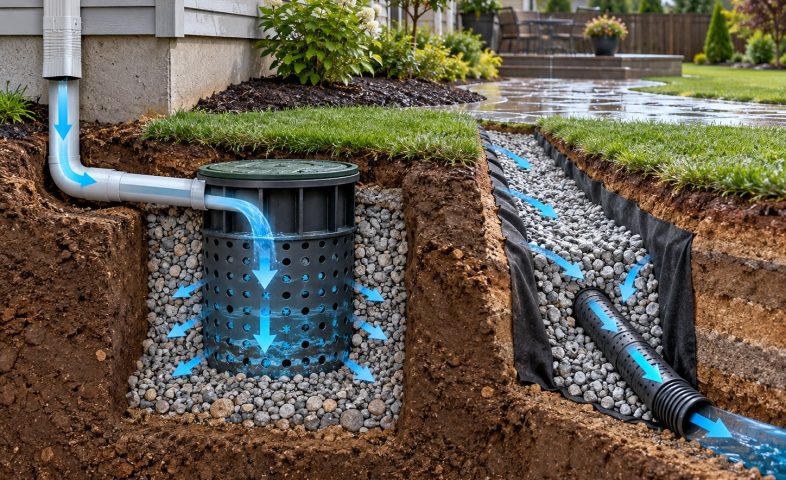
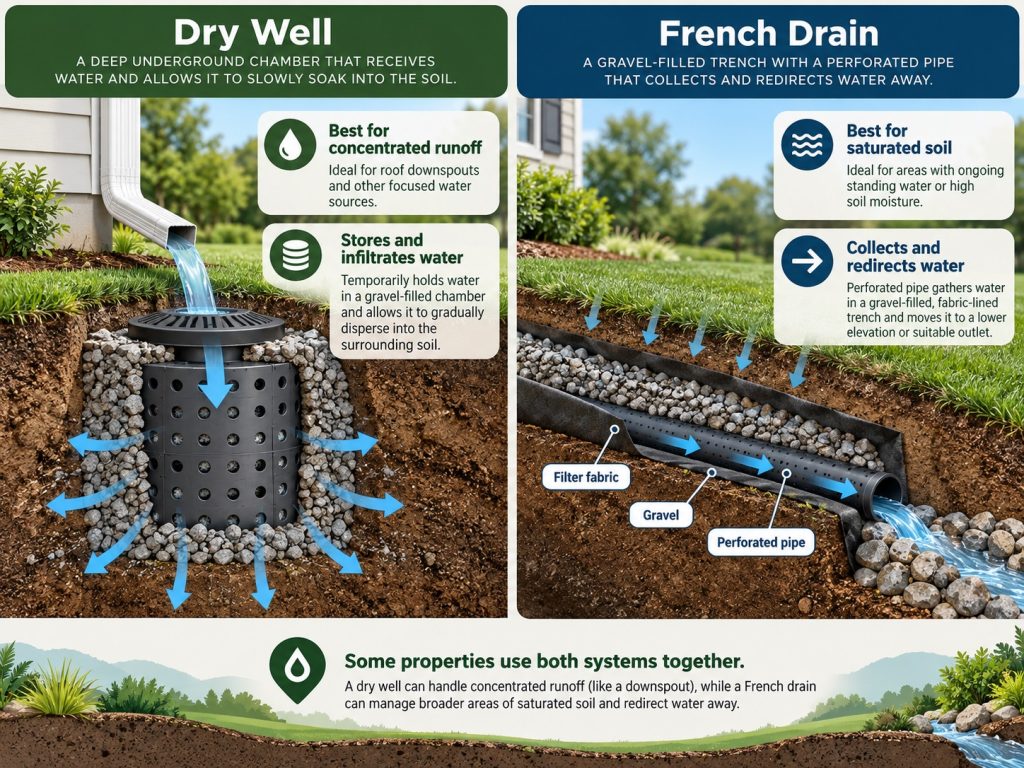
A dry well and French drain solve different water problems. A French drain collects water from saturated soil and redirects it through a gravel-filled trench and perforated pipe. A dry well temporarily stores collected runoff underground and allows it to soak into suitable surrounding soil. In some yards, the two systems work together, with a French drain carrying water to a dry well.
Standing water, soggy grass, downspout runoff, and wet areas around a home do not always require the same drainage solution.
At Valley View Excavating, LLC, we start by determining where the water comes from, how it moves across the property, and where it can safely go. That evaluation helps us decide whether a French drain, dry well, grading correction, catch basin, buried downspout, or combination of systems makes the most sense.
What Is a French Drain?
A French drain is an underground drainage system designed to collect and redirect water.
A typical system includes:
- An excavated trench
- Filter fabric
- Clean drainage stone
- Perforated drainage pipe
- A properly planned outlet
Water enters through the surrounding stone and pipe perforations, then moves toward a lower discharge point.
French drains are especially useful for:
- Soggy lawns
- Persistent subsurface moisture
- Water behind retaining walls
- Saturated soil
- Foundation-side drainage
- Low areas that remain wet after rainfall
Valley View uses French drains as part of broader yard drainage solutions, with trench depth, pipe pitch, stone, fabric, soil, grading, and discharge location planned around the property.
What Is a Dry Well?
A dry well is an underground structure designed to temporarily store water and allow it to infiltrate into surrounding soil.
Modern systems may use a perforated chamber surrounded by washed stone rather than simply a stone-filled hole.
Water can enter a dry well from:
- Buried downspout piping
- Drainage piping
- Catch basins
- Other suitable stormwater sources
The EPA’s New England stormwater guidance describes a dry well as a subsurface perforated structure surrounded by washed crushed stone that stores runoff temporarily while allowing it to infiltrate surrounding and underlying soils.
Dry wells work best only where the soil and groundwater conditions allow water to infiltrate effectively.
Dry Well vs. French Drain: What’s the Difference?
The main difference is what each system does with water.
| Feature | French Drain | Dry Well |
|---|---|---|
| Main job | Collects and redirects water | Stores and infiltrates water |
| Shape | Long drainage trench | Concentrated underground chamber |
| Pipe | Usually perforated | Often receives solid drainage pipe |
| Best for | Saturated soil and subsurface water | Concentrated runoff needing an infiltration point |
| Needs an outlet? | Usually yes | Soil acts as the discharge area |
| Depends on soil infiltration? | Less directly | Very strongly |
| Can work together? | Yes | Yes |
A French drain is primarily a collection and conveyance system.
A dry well is primarily an infiltration and storage system.
When Is a French Drain Better?
A French drain may be the better choice when water is spread across a larger area rather than concentrated at one point.
Common examples include a lawn that stays soggy for days, groundwater moving through a slope, water collecting behind a retaining wall, or soil remaining saturated around a low area.
The perforated pipe creates a path for that subsurface water to move toward an appropriate outlet.
Our related guide comparing a curtain drain vs. French drain explains how water moving across a slope differs from deeper groundwater and saturated-soil problems.
When Is a Dry Well Better?
A dry well may make sense when water already has a clear collection point but there is no practical surface outlet.
One common example is roof runoff.
A buried solid pipe can move water from a downspout toward a properly sized dry well, where the runoff is temporarily stored and dispersed underground.
Dry wells may be useful where:
- Daylight drainage is not practical
- Roof runoff needs a discharge location
- Surface space is limited
- Soil drains well enough for infiltration
- Groundwater conditions provide adequate separation
Dry wells should not simply be installed anywhere water collects. Soil, groundwater, utility locations, runoff volume, and local requirements all matter.
For an authoritative technical overview, see the EPA New England Stormwater Retrofit Manual. US EPA
Can a French Drain Empty Into a Dry Well?
Yes. On the right property, a French drain and dry well can work as one drainage system.
The French drain collects unwanted groundwater or subsurface moisture and carries it through piping.
The dry well provides an underground destination where that water can temporarily collect and infiltrate.
Valley View already identifies dry wells as one possible outlet for French drains when site conditions support that approach.
However, connecting the two only works when the dry well can accept the expected water volume and the surrounding soil can drain it.
Why Soil Type Matters for a Dry Well
A dry well depends on infiltration.
Water entering the chamber needs to move into surrounding native soil at a reasonable rate.
Poorly draining or saturated soil may cause the dry well to remain full rather than empty between storms. A high seasonal groundwater table can create another limitation.
This is why we evaluate soil and site conditions before treating a dry well as an automatic solution.
A French drain also depends on good planning, but its purpose is usually to move water somewhere else rather than relying entirely on local infiltration.
What About Connecticut Clay, Rock, and Ledge?
Connecticut properties can contain compacted soils, glacial material, boulders, and shallow ledge.
Those conditions matter.
Rock may complicate excavation. Dense soil can limit infiltration. Existing grades may leave no gravity outlet. Groundwater can also affect how a drainage system performs.
We evaluate these factors before excavation so the system is designed around the actual property rather than a generic drainage diagram.
Can a Dry Well Fix a Soggy Lawn?
Not necessarily.
A dry well can receive water, but it does not automatically collect moisture spread throughout saturated soil.
If a lawn remains wet because groundwater or subsurface water is moving through the area, a French drain may be needed to collect that water first.
The dry well could then become the outlet if conditions permit.
Can a French Drain Handle Downspout Water?
We generally avoid treating every downspout as another French-drain inlet.
Roof runoff creates a large amount of concentrated water very quickly. Solid buried drainage pipe is often better for moving gutter water directly away from the home without intentionally releasing that water through perforations into already wet soil.
A drainage plan may therefore combine solid downspout piping, French drains, catch basins, grading, and a dry well.
Which Drainage System Does Your Property Need?
Choose based on the water problem, not the product name.
Consider a French drain when: water is spread through saturated soil and needs to be collected and redirected.
Consider a dry well when: collected runoff needs underground storage and suitable soil is available for infiltration.
Consider both when: water must first be collected and then discharged into an underground infiltration area.
At Valley View Excavating, LLC, we evaluate grading, soil, groundwater, downspouts, trench routes, pipe pitch, drainage stone, access, and discharge options before recommending a system.
The goal is not simply to get water underground. The goal is to control where it goes after it gets there.
Frequently Asked Questions
Is a dry well better than a French drain?
Neither is universally better. French drains collect and redirect water, while dry wells store water and allow it to infiltrate into suitable soil.
Can a French drain connect to a dry well?
Yes. A French drain can collect water and discharge into a properly designed dry well when soil, groundwater, capacity, and site conditions allow it.
Does a dry well have a perforated pipe?
Dry wells can use perforated chambers or other infiltration structures surrounded by drainage stone. The exact design depends on the application.
How long does a dry well take to drain?
Drain time depends on soil infiltration, system size, groundwater conditions, and the amount of water entering the system.
Is a French drain good for standing water?
It can be, especially when standing water is related to saturated soil or subsurface water. Surface grading or another drainage system may be better when runoff is the main cause.