
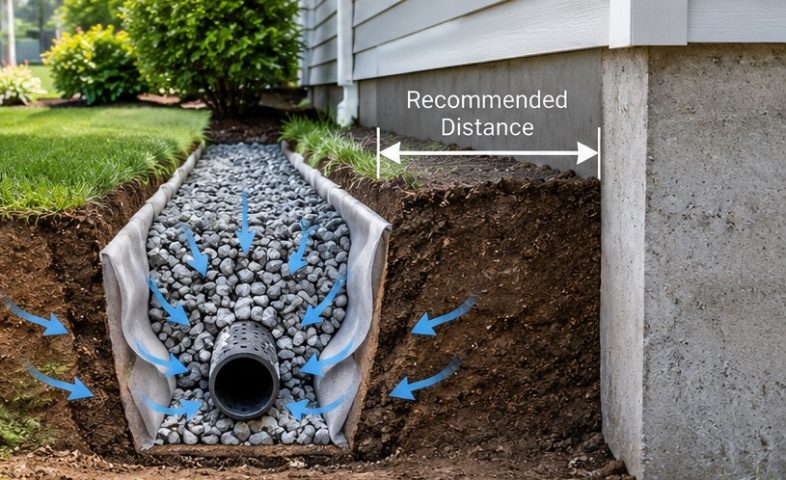
There is no universal French drain distance from a house. A foundation footing drain is typically installed directly outside the foundation footing, while a yard French drain or curtain drain may be positioned farther uphill to intercept water before it reaches the home. The often-recommended 10-foot distance applies to certain drainage discharge locations, not every French drain trench. Proper placement depends on soil conditions, foundation depth, grading, and where collected water can safely discharge.
How Far Should a French Drain Be From Your House?
Water collecting around a foundation can eventually lead to basement leaks, saturated soil, and moisture damage.
At Valley View Excavating, LLC, we help Connecticut homeowners determine where drainage systems should be installed to manage excess water effectively.
One of the most common questions involves how close a French drain should be to the foundation.
The answer depends on what the drainage system needs to accomplish.
A French drain designed to intercept groundwater uphill from a home has different placement requirements than a foundation footing drain.
Understanding that distinction helps prevent unnecessary excavation and poor drainage performance.
French Drain Placement: Understanding the Different Systems
Not every underground drainage system should be installed the same distance from a building.
| Drainage System | Typical Placement | Main Purpose |
|---|---|---|
| Foundation footing drain | Directly outside the footing | Collect water near the foundation base |
| Yard French drain | At a wet area or along a subsurface water path | Redirect saturated-soil water |
| Curtain drain | Uphill from the area requiring protection | Intercept water moving downhill |
| Solid discharge pipe | Carries water to a safe outlet | Move collected water away from the home |
A professionally designed system considers water movement, soil conditions, and the elevation of the drainage outlet.
1. French Drains Installed Along the Foundation
A foundation drainage system is designed to collect groundwater before it accumulates against below-grade walls.
Unlike a yard drain, a footing drain is typically positioned close to the foundation.
According to the U.S. Department of Energy’s Building America Solution Center, a footing drain should sit outside the footing rather than directly on top of it, with the pipe positioned below the basement slab or crawlspace floor.
The system generally includes:
- Perforated drainage pipe
- Clean washed drainage stone
- Filter fabric to limit sediment intrusion
- Proper pipe slope
- An approved discharge location
We recommend professional evaluation before excavating beside an existing foundation.
Digging below or undermining a footing without appropriate engineering precautions can compromise structural stability.
2. How Far Should a Yard French Drain Be From Your House?
A yard French drain does not necessarily need to sit against the foundation.
When water moves downhill toward a home, an interceptor drain may be installed uphill to collect the water before it reaches the building.
The appropriate location depends on:
- Property slope and elevation
- Direction of groundwater movement
- Soil permeability
- Existing utilities and structures
- Trench depth
- Available drainage outlets
For example, a Connecticut home located below a sloped backyard may benefit from a curtain drain positioned across the slope.
We evaluate where water enters the property before choosing a trench location.
Our related article on curtain drains vs. French drains explains how these systems handle different drainage conditions.
3. Should a French Drain Discharge 10 Feet From the House?
In many drainage designs, discharging collected water at least 10 feet from the foundation is recommended when a suitable downhill outlet is available.
However, homeowners sometimes confuse discharge distance with trench placement.
These are different measurements.
A foundation drain may collect water directly beside the footing while a connected solid pipe carries that water away from the house.
The Department of Energy’s Building America guidance describes foundation drainage systems that discharge to daylight at least 10 feet from the foundation or use suitable alternatives, such as a properly designed dry well, approved stormwater connection, or sump system.
The discharge location must prevent water from returning toward the foundation.
Local stormwater requirements and property conditions may affect the final design.
4. Why Proper Grading Matters
Even a correctly positioned French drain may perform poorly when the surrounding ground directs water toward the house.
For surface drainage, Building America recommends sloping permeable ground away from the foundation at approximately ½ inch per foot for the first 10 feet where feasible.
When a property has limited space, alternative drainage systems may be necessary.
At Valley View Excavating, we evaluate grading alongside subsurface drainage because both influence long-term performance.
Our yard drainage solutions include French drains, drainage piping, grading improvements, and other water management systems.
5. Common French Drain Installation Mistakes
Improper placement can create problems even when quality materials are used.
We recommend avoiding these mistakes:
Excavating Too Close to Structural Footings: Unplanned excavation can disturb soil supporting the foundation.
Installing a Drain Without an Outlet: Collected water needs a reliable discharge destination.
Using the Wrong Gravel: Aggregate containing excessive fines can restrict water movement.
Connecting Downspouts Directly to Foundation Drainage: Large amounts of roof runoff can overwhelm the system. Dedicated solid piping is often preferable.
Ignoring Soil Conditions: Clay, bedrock, and seasonal groundwater levels influence the appropriate drainage design.
Connecticut’s freeze-thaw conditions and variable soils make correct installation especially important.
When Should You Hire a Drainage Contractor?
We recommend professional assessment when water repeatedly collects near the foundation, basement leaks continue after rainfall, or the property has a steep slope.
Other warning signs include persistent soggy soil, foundation-side erosion, and groundwater entering below-grade spaces.
A professional evaluation can identify whether the problem requires a footing drain, French drain, curtain drain, downspout extension, or grading correction.
Frequently Asked Questions
Can a French drain be installed right next to a foundation?
Yes. Foundation footing drains are designed to sit close to the footing. However, excavation beside an existing foundation requires proper planning to avoid structural damage.
Is 10 feet the required French drain distance from a house?
No. Ten feet is commonly associated with drainage discharge and surface grading guidance, not a universal setback for every French drain.
How deep should a French drain be near a house?
Depth depends on the drainage purpose. Foundation footing drains are installed near footing level, while yard drains are designed around soil conditions, groundwater, and drainage requirements.
Can a French drain damage a foundation?
Improper excavation, unsupported soil, or poorly planned discharge can create risks. Professional design and installation help protect the foundation.
Protect Your Foundation With Valley View Excavating
The correct French drain distance from your house depends on where the unwanted water originates and how it can be redirected safely.
At Valley View Excavating, LLC, we provide professional excavation, grading, and drainage solutions throughout Plainville and surrounding Central Connecticut communities.
Whether you’re dealing with a wet basement, saturated lawn, or runoff near your foundation, we’ll evaluate the property and recommend an appropriate drainage approach.