
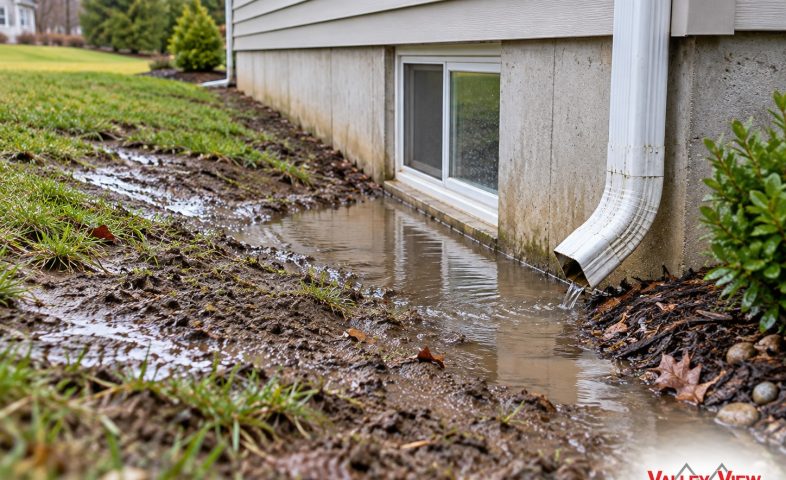
Negative grading around a house means the soil slopes toward the foundation instead of away from it. That slope can direct rain, snowmelt, and roof runoff toward basement walls, increasing the chance of pooling water, dampness, and foundation-related drainage problems. To correct it, we typically reshape and compact suitable soil so water moves away from the home toward a safe discharge area. University of Georgia Cooperative Extension recommends creating about a 5% grade away from the home for at least 10 feet where site conditions allow.
At Valley View Excavating, LLC, we look beyond the wet spot itself. Correcting basement water grading means understanding where water starts, how it crosses the property, and where it can safely go after the grade is changed.
What Is Negative Grading Around a House?
A properly graded yard directs surface water away from the foundation.
Negative grading does the opposite. When the soil slopes toward the house, rainfall and melting snow naturally travel downhill toward the foundation. Water may collect against basement walls or remain trapped in low areas near the home.
Over time, grading can change because soil settles, landscaping is altered, topsoil erodes, or patios and walkways are installed at unsuitable elevations.
Warning signs can include:
- Standing water next to the foundation
- Wet soil long after rainfall
- Basement dampness or leaks
- Mulch washing toward the house
- Erosion around foundation walls
- Water flowing toward basement doors or window wells
Water near a foundation is not always caused by grading alone. Downspouts, groundwater, hardscape runoff, and drainage system failures can contribute as well.
Why Foundation Grading Matters
Surface water follows gravity. If the ground slopes toward the structure, the foundation becomes the low point.
The University of Georgia recommends establishing a 5% slope away from a home for at least 10 feet where possible. That equals roughly 6 inches of fall across 10 feet.
That does not mean every property can be fixed by simply dumping six inches of soil beside the house. Door thresholds, siding, basement windows, utility penetrations, walkways, retaining walls, and property boundaries can all limit how much elevation can safely be changed.
Our approach starts with the actual elevations rather than guessing based on appearance.
How We Regrade Around a Foundation
When we regrade around a foundation, the goal is to create a controlled path for surface runoff.
1. Evaluate Existing Elevations
We first determine where high and low areas are located. We also inspect downspouts, nearby patios, driveways, walkways, retaining walls, and natural slopes.
Valley View Excavating’s yard drainage services begin with evaluating how water enters, travels across, and leaves the property. Regrading may be recommended when the ground slopes toward the home or traps runoff in low areas.
2. Remove Unsuitable Material
Loose mulch, roots, organic debris, and unstable material may need to be removed before establishing a dependable grade.
Simply covering a drainage problem with loose topsoil may provide only a temporary cosmetic improvement.
3. Add and Compact Suitable Soil
We place suitable fill in controlled layers and shape it so the finished surface falls away from the foundation.
Compaction matters. Poorly compacted fill can settle, creating another low spot that directs water back toward the house.
4. Create a Safe Water Path
Moving water away from the foundation only solves half the problem.
The runoff still needs somewhere safe to travel. We avoid creating a grade that simply pushes water toward a neighbor, driveway, septic area, retaining wall, or another problem location.
What If There Is Not Enough Room to Regrade?
Some homes have narrow side yards, steep terrain, low windows, or hardscapes that make a full grading correction difficult.
That is when we may combine grading with another drainage solution.
Depending on the property, the plan could involve a French drain, catch basin, buried downspout line, curtain drain, dry well, or foundation drainage system. Valley View Excavating frequently combines regrading with drainage improvements when one solution alone cannot control the water.
Our related guide on French drains versus dry wells explains how those systems manage different types of yard water.
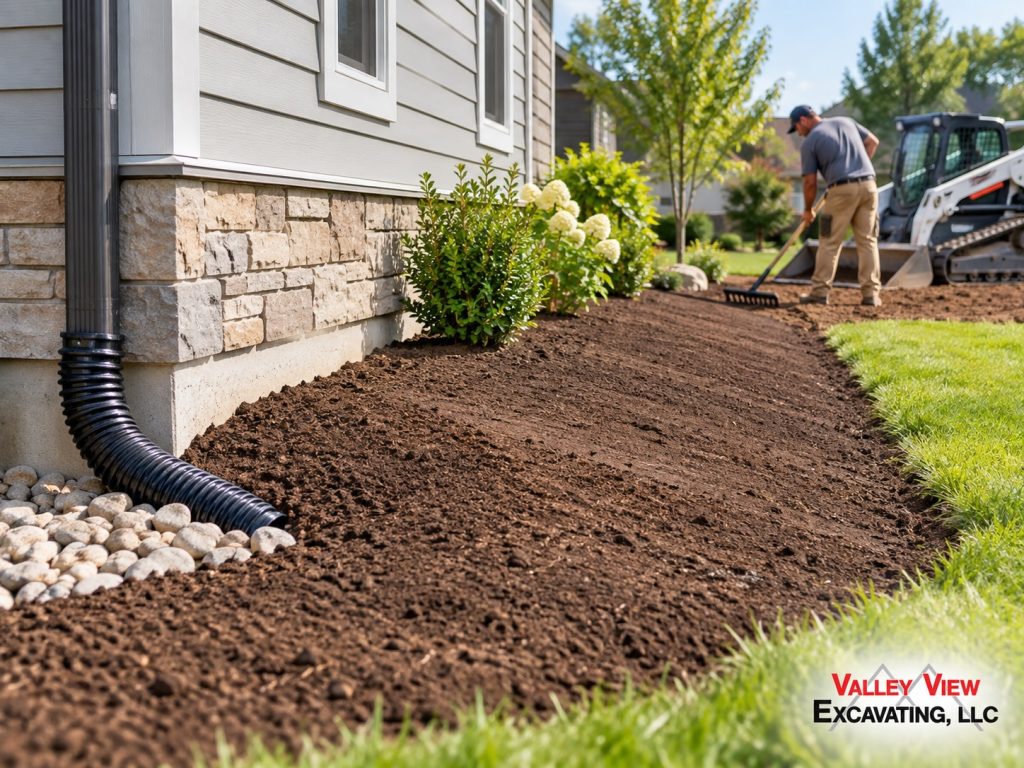
Do Downspouts Affect Basement Water Grading?
Absolutely.
Even a properly sloped yard can struggle when downspouts release concentrated roof runoff directly beside the foundation.
A roof collects a large amount of water during a storm. When that runoff exits at the base of the home, the surrounding soil can quickly become saturated.
Our drainage work often includes buried downspout piping that carries roof water to a safer discharge point. Combining proper grading with better downspout management can reduce the amount of water reaching the foundation in the first place.
Can Landscaping Create Negative Grading?
Yes.
Years of adding mulch, planting beds, landscape edging, or soil can gradually change drainage patterns. A raised planting bed against the house may unintentionally trap water if the surrounding grade no longer drains outward.
Before adding more material around a foundation, we recommend checking where water will flow after the work is complete.
The finished landscape should look good, but drainage performance comes first.
When Should a Homeowner Call a Grading Contractor?
A small shallow depression may be manageable as a landscaping project. Repeated basement water, significant elevation changes, large quantities of soil, buried utilities, drainage structures, or excavation close to the foundation deserve a more careful evaluation.
At Valley View Excavating, LLC, we evaluate the whole drainage pattern before moving soil.
When negative grading around a house is the real cause, correcting the slope can provide a straightforward way to redirect surface water. When additional drainage problems are present, we can build grading, underground drainage, and runoff control into one coordinated plan.
The goal is simple: water should move away from the home instead of toward it.